Today's
EarthStation1.com 15% Off Commemorative Memorial Title: Archival
Cartoon Classics #3 Fables & Fairy Tales MP4 Download DVD
Today, June 23, 2026
June 23: National Porridge Day: --
Whether sweet or savory, with fruit or with stews, we love
porridge, and are holding our spoons at the ready to dig into this
dish today! Rich, flavorful, and thankfully not the 'breakfast of
champions,' porridge is healthy and wholesome. Made by boiling
grain in milk, the result is a choice breakfast for people around
the world. The mushy bowl may seem bland to some, but not to us!
The history of porridge is as rich as the dish itself. Before the
invention of baking ovens, porridge was the most essential part of
the British diet. Porridge, or gruel, has been indulged in
cross-culturally for centuries. The origins of porridge can be
traced to Northern Europe, where it was traditionally enjoyed
savory. The word 'porridge' first appeared in the 16th century and
is believed to be a spin-off of the word 'pottage' - a type of
stew. Porridge hasn't always been the way it is today. Preparation
ingredients varied from grass-borne grains to other crops. Quinoa
grain has been used for making porridge for more than 3,000 years,
whereas rice porridge was eaten in China since 2500 B.C. It goes
back even further than this, with evidence discovered by
researchers proving that the cooked mush was eaten in some form as
far back as 12,000 years ago, at the beginning of the Neolithic
Revolution. Soon after, people started preparing thick pancakes on
stone ovens or hot tiles, using porridge-like mixtures. Such
flatbreads are mentioned throughout the Old Testament, but a
similar innovation simultaneously occurred throughout the world.
The popularity of porridge and its many variations led to the
creation of corn cakes, cornbreads, corn puddings, etc. In recent
years, there has been a renewed interest in porridge. Artisan
cooks and high-profile chefs are experimenting with the bland
ingredients of porridge to blend and create different flavors
around the world. On Sale @ 15% Off Discount Till Midnight PT!
https://store.earthstation1.com/archival-cartoon-classics-3-fables-amp-fairy-tales-mp4-download-d34.html
Today's
EarthStation1.com 15% Off Commemorative Memorial Title: La Belle
Epoque 1890-1914 DVD, MP4 Video Download, USB Flash Drive
Today, June 23, 2026
June 23: International Olympic Day: --
June 23, 1894: The International Olympic Committee is founded at
the Sorbonne in Paris, at the initiative of Baron Pierre de
Coubertin. In honor of this founding, International Olympic Day is
celebrated. First observed in 1948, The Olympics is the world's
largest international multi-sport event held every four years.
Thousands of athletes and sportspersons from all across the world
take part in various games and sports. The modern Olympic Games
are inspired by the Greek's ancient Olympic Games held in Olympia,
from the eighth century B.C. to the fourth century A.D. The first
modern Summer Olympic Games were held in 1896 in Athens, Greece.
Since its foundation, International Olympic Day has widened its
audience and has adapted to various local specificities. In 1947,
a member of the International Olympics Committee in
Czechoslovakia, Dr. Josef Gruss, presented a report about World
Olympic Day in Stockholm. Later in the 42nd I.O.C. Session at St
Moritz in January 1948, the idea for Olympic Day was adopted. With
mutual consultation, June 23 was chosen to celebrate the
foundation of the I.O.C. Its motivation was to convey a message to
the young people by promoting the idea of sports among them. In
ancient Greece, in honor of Zeus, the father of all Greek gods, a
religious festival was held each year. The Olympic Games were part
of that festival. It began in 776 B.C. when a cook from the city
of Elis won a 600-foot-long foot race. For the first 13 years, it
was the only athletic event of the games. Later from 776 B.C.,
Olympics were held every four years for about 12 centuries. The
day is celebrated to promote and spread awareness about the
Olympic Movement, and to encourage more and more people to take
part in the Olympic Games. Athletes and sportsmen from almost all
nations participate in sports activities, such as runs, music,
exhibitions, different sports, games, and educational seminars on
the day. The Olympics Day has three pillars - Move, Learn, Detect.
The National Olympic Committee encourage the participation of all
regardless of their gender, age, social background, etc. On Sale @
15% Off Discount Till Midnight PT!
https://store.earthstation1.com/la-belle-epoque-18901914-western-high-society-cul18901914.html
Today's
EarthStation1.com 15% Off Commemorative Memorial Title: American
Business Films Of The 20th Century MP4 Video Download DVD
Today, June 23, 2026
June 23: National Typewriter Day: -- June
23, 1868: Great Inventions: Christopher Latham Sholes, Frank Haven
Hall, Carlos Glidden and Samuel W. Soule in Milwaukee, Wisconsin
receive a patent for an invention called the "Type-Writer",
the first typewriter to be commercially successful. The working
prototype was made by clock-maker and machinist Matthias
Schwalbach. Hall, Glidden and Soule sold their shares in the
patent (US 79,265) to Densmore and Sholes, who made an agreement
with E. Remington and Sons (then famous as a manufacturer of
sewing machines) to commercialize the machine as the Sholes and
Glidden Type-Writer. This was the origin of the term typewriter.
Remington began production of its first typewriter on March 1,
1873, in Ilion, New York. It had a QWERTY keyboard layout, which,
because of the machine's success, was slowly adopted by other
typewriter manufacturers. As with most other early typewriters,
because the typebars strike upwards, the typist could not see the
characters as they were typed. Sholes soon disowned the machine
and refused to use or even recommend it. On Sale @ 15% Off
Discount Till Midnight PT!
https://store.earthstation1.com/american-business-films-1910s1960s-3-dual-laye191019603.html
Today's
EarthStation1.com 15% Off Commemorative Memorial Title: United
Nations Documentaries Set: 2 MP4 Downloads Or 2 DVDs
Today, June 23, 2026
June 23: United Nations Public Service
Day: -- Celebrates the value and virtue of public services,
emphasizes the contribution of public service in the process of
development, recognizes the work of public servants, and
encourages young people to pursue careers in the public sector. In
2003, the United Nations established the UN Public Service Awards
(UNPSA) program, which aims to promote and reward innovation and
excellence in public services. It was then reviewed in 2016 to
align with the 2030 Agenda for Sustainable Development. On
December 20, 2002, the General Assembly designated June 23 as
United Nations Public Service Day. It encouraged the Member States
to organize special events on the day highlighting the
contribution of public service in the development process. The
UNPSA was then established. This organization rewards the
accomplishments and contributions of public service institutions
that lead to a more effective and responsive public administration
in countries worldwide. The UNPSA advertises the role,
professionalism, and visibility of public service. Public service
and public servants are crucial to the community. Public service
is a service provided to people in a specific jurisdiction by the
government. The government itself may provide the services, or
they pay a private organization to provide the services to the
people. The police or fire department, for example, is a
government-run agency, but trash pickup provided by an independent
contractor is a public service financed by the jurisdiction.
Public servants don't just do a job, but they want to make a
difference. They put others first because they want to give back
to their community. Being a public servant means working hard and
being dedicated to serving citizens. Public servants work in
different fields of jobs and different ministries, but they use
the same values as the basis of their services. One of their
values is integrity, which is important in building trust. The
public's trust in government is based on how they feel about the
services provided to them by public servants. On Sale @ 15% Off
Discount Till Midnight PT!
https://store.earthstation1.com/united-nations-documentaries-set-dvd-mp4-download-usb-driv4.html
Today's
EarthStation1.com 15% Off Commemorative Memorial Title: The Incas
Remembered: Historical Documentary DVD, MP4, USB Stick
Today, June 23, 2026
June 23, 1572: The Spanish Colonization
Of The Americas: Indigenous Rebellions In Mexico And Central
America: The Spanish Conquest Of The Inca Empire (The Conquest Of
Peru): The Neo-Inca State (The Neo-Inca State Of Vilcabamba): The
Final Conquest Of The Neo-Inca State: -- The Inca, in their final
form as The Neo-Inca State, also known as the Neo-Inca state of
Vilcabamba, ceases to exist as the Neo-Inca State fort of Huayna
Pucara surrenders to Spanish artillery fire. The Inca army, now in
retreat, opted to abandon their last city and head for the jungle
to regroup. The following day, June 24, the Spanish entered the
city of Vilcabamba to find it deserted and the Sapa Inca gone. The
city had been entirely destroyed, and the Inca leader Tupac Amaru
was later captured and executed by the Spanish. The attack on
Huayna Pucara had begun three weeks prior, on June 1, 1572, when
Francisco De Toledo, the fifth Viceroy of Peru who was known as
The Viceroyal Solon, led the first engagement of the Spanish
against the Neo-Inca State in the Vilcabamba valley near the Inca
capital of Vilcabamba, Peru. The Neo-Inca State/Neo-Inca State Of
Vilcabamba, was the Inca state established in 1537 at Vilcabamba
as a rump state of the Inca Empire (1438-1533), which collapsed
after the Spanish conquest in the mid-1530s. The Inca initially
attacked the Spanish with high morale, despite being poorly
equipped. Repeatedly, the Inca attempted to lift the siege held by
the Spanish and their native allies but were forced to retreat. On
Sale @ 15% Off Discount Till Midnight PT!
https://store.earthstation1.com/the-incas-remembered-historical-documentary-dvd-mp4-us4.html
Today's
EarthStation1.com 15% Off Commemorative Memorial Title: The
Western Tradition TV Series DVD, MP4 Video Download, USB Drive
Today, June 23, 2026
June 23, 1611: The Age Of Discovery (The
Age Of Exploration): The Expeditions Of Henry Hudson: The
Expedition of 1610-1611 (The Fourth Expedition Of Henry Hudson):
-- The mutinous crew of Henry Hudson's fourth voyage sets Henry,
his son and seven loyal crew members adrift in an open boat in
what is now Hudson Bay; they are never heard from again. After
wintering on the shore of James Bay, a large body of water located
on the southern end of Hudson Bay in what is now Canada, Hudson
wanted to press on to the west to continue his search for a
Northwest Passage to Asia. When the ice cleared in the spring of
1611, Hudson planned to use his British East India Company light
Dutch flyboat vessel of Discovery to further explore Hudson Bay
with the continuing goal of discovering the Passage; however, most
of the members of his crew ardently desired to return home.
Matters came to a head and much of the crew mutinied in June.
Descriptions of the successful mutiny are one-sided, because the
only survivors who could tell their story were the mutineers and
those who went along with the mutiny. In the latter class was
ship's navigator, Abacuk Pricket, a survivor who kept a journal
that was to become one of the sources for the narrative of the
mutiny. According to Pricket, the leaders of the mutiny were Henry
Greene and Robert Juet. The latter, a navigator, had accompanied
Hudson on the 1609 expedition, and his account is said to be "the
best contemporary record of the voyage". Pricket's narrative
tells how the mutineers set Hudson, his teenage son John, and
seven crewmen -- men who were either sick and infirm or loyal to
Hudson -- adrift from the Discovery in a small shallop, an open
boat, effectively marooning them in Hudson Bay. The Pricket
journal reports that the mutineers provided the castaways with
clothing, powder and shot, some pikes, an iron pot, some food, and
other miscellaneous items. After the mutiny, Hudson's shallop
broke out oars and tried to keep pace with the Discovery for some
time. Pricket recalled that the mutineers finally tired of the
David-Goliath pursuit and unfurled additional sails aboard the
Discovery, enabling the larger vessel to leave the tiny open boat
behind. Hudson and the other seven aboard the shallop were never
seen again. Despite subsequent searches, including those conducted
by Thomas Button in 1612 and by Zachariah Gillam in 1668-1670,
their fate is unknown. While Pricket's account is one of the few
surviving records of the voyage, its reliability has been
questioned by some historians. Pricket's journal and testimony
have been severely criticized for bias, on two grounds. Firstly,
prior to the mutiny the alleged leaders of the uprising, Greene
and Juet, had been friends and loyal seamen of Hudson. Secondly,
Greene and Juet did not survive the return voyage to England
(Juet, who had been the navigator on the return journey, died of
starvation a few days before the company reached Ireland). Pricket
knew he and the other survivors of the mutiny would be tried in
England for piracy, and it would have been in his interest, and
the interest of the other survivors, to put together a narrative
that would place the blame for the mutiny upon men who were no
longer alive to defend themselves. The Pricket narrative became
the controlling story of the expedition's disastrous end. Only
eight of the thirteen mutinous crewmen survived the return voyage
to Europe. They were arrested in England, and some were put on
trial, but no punishment was imposed for the mutiny. One theory
holds that the survivors were considered too valuable as sources
of information to execute, as they had travelled to the New World
and could describe sailing routes and conditions. In 1612, Nicolas
de Vignau, companion of French explorer Samuel de Champlain in New
France, claimed he saw wreckage of an English ship on the shores
of James Bay, located on the southern end of Hudson Bay. Champlain
said of de Vignau in his writings "[He is] the most impudent
liar that has been seen for a long time", so while de Vignau
account was discounted at the time by de Champlain, historians
believe it may have credence. British-born Canadian author Dorothy
Harley Eber (1925-2022) collected Inuit testimonies that she
thought made reference to Hudson and his son after the mutiny.
According to these, an old man with a long white beard and a young
boy arrived in a small wooden boat. The Inuit had never seen a
white person before, but they took them to an encampment and fed
them. After the old man died, the Inuit tethered the boy to one of
their houses so he would not run away. Despite the long time
passed, the story might be given some credence after long-ignored
Inuit testimonies proved reliable enough to lead to the discovery
of the wrecks of the two ships in Franklin's lost expedition, HMS
Erebus and HMS Terror, in the 2010s. Charles Francis Hall, who
searched for Franklin in the mid-19th century, also collected
Inuit stories that he interpreted as references to the even
earlier expedition of Martin Frobisher, who explored the area and
mined fool's gold in 1578. In the late 1950s, a 150-pound (68 kg)
stone near Deep River, Ontario, which is approximately 600
kilometres (370 mi) south of James Bay, was found to have carving
on it with Hudson's initials (H. H.), the year 1612, and the word
"captive". While lettering on the stone was consistent
with English maps of the 17th century, the Geological Survey of
Canada was unable to determine when the carving was made. The bay
visited by and named after Hudson is three times the size of the
Baltic Sea, and its many large estuaries afford access to
otherwise landlocked parts of Western Canada and the Arctic. This
allowed the Hudson's Bay Company to exploit a lucrative fur trade
along its shores for more than two centuries, growing powerful
enough to influence the history and present international
boundaries of western North America. Henry Hudson, English sea
explorer and navigator during the early 17th century, best known
for his explorations of present-day Canada and parts of the
northeastern United States (c. 1565 - disappeared June 23, 1611)
was probably born in London, England. Virtually nothing of
Hudson's early life is known for certain; his year of birth is
variously estimated between 1560 and 1570, and it is possible that
his father was an alderman of London. When Hudson first entered
the historical record in 1607, he was already an experienced
mariner with sufficient credentials to be commissioned the leader
of an expedition charged with a search for a trade route across
the North Pole. In 1607 and 1608, Hudson made two attempts on
behalf of English merchants to find a rumoured Northeast Passage
to Cathay via a route above the Arctic Circle. In 1609, he landed
in North America on behalf of the Dutch East India Company and
explored the region around the modern New York metropolitan area.
Looking for a Northwest Passage to Asia on his ship Halve Maen
("Half Moon"), he sailed up the Hudson River, which was
later named after him, and thereby laid the foundation for Dutch
colonization of the region. Along with Hudson Bay and Hudson
Strait in Canada, and the Hudson River in New York and New Jersey,
many other topographical features and landmarks are named for
Hudson. Hudson County, New Jersey on the shores of The Hudson
River is named after him, as are the Henry Hudson Bridge, the
Henry Hudson Parkway, and the city of Hudson, New York. Henry
Hudson's contributions to the exploration of the New World were
significant and lasting. His voyages helped to establish European
contact with the native peoples of North America and contributed
to the development of trade and commerce. On Sale @ 15% Off
Discount Till Midnight PT!
https://store.earthstation1.com/the-western-tradition-dvd-set-all-52-shows-13-d5213.html
Today's
EarthStation1.com 15% Off Commemorative Memorial Title: Pirates 12
Part Documentary Series MP4 Video Download DVD
Today, June 23, 2026
June 23, 1662: #DOTD: Zheng Chenggong
(Wade-Giles romanization: Cheng Ch'eng-Kung), Western name
Koxinga, or Coxinga, pirate leader of Ming forces against the
Manchu conquerors of China, best known for establishing Chinese
control over Taiwan (b. August 27, 1624) #dies of malaria, only a
few months after defeating the Dutch in Taiwan, in Anping, Kingdom
Of Tungning (modern Southwest Taiwan) at the age of 37. There were
speculations that he died in a sudden fit of madness when his
officers refused to carry out his orders to execute his son Zheng
Jing, who had had an affair with his wet nurse and conceived a
child with her. As Koxinga descended into death, he relented and
agreed to let his son Zheng Jing succeed him as King Of Tungning.
Koxinga died as he passed into delirium and madness and expressed
his regrets to his family and father. He was buried in The Koxinga
Ancestral Shrine (Chinese: Zhengchenggong Zumiao), a family shrine
built in the West Central District, Tainan, Taiwan in 1663 by
Koxinga's on Zheng Jing, the same son Koxinga had ordered killed,
in order to worship his father. Tainan, now officially known as
Tainan City, is a special municipality in southern Taiwan facing
the Taiwan Strait on its western coast, the oldest city on the
island and now commonly called the "prefectural capital"
of Taiwan. When Taiwan became part of the Qing dynasty during The
Manchu Conquest Of China, the Qing moved Koxinga's grave in 1699
across the Taiwan Strait to Fujian on the southeastern coast of
mainland China, and the shrine was renamed "Zheng's Ancestral
Hall" (Chinese: Zheng Shi Da Zongci). The Qing then banned
Koxinga worship, but the people of Taiwan continued to worship him
secretly under the name "Prince Zhu". In 1897, the
shrine was converted into a Shinto shrine by the Japanese
government and renamed Kaizan Shrine (Japanese: Kaizan Jinja) by
the Imperial government during the Japanese occupation of Taiwan.
The Japanese intended to downplay Koxinga's historical reputation
and legacy as a folk hero in order to legitimize their rule of
Taiwan. The conversion of the shrine was part of a larger
assimilation campaign to advance idea that Taiwan was always
separate from China. In the 1960s, the shrine was converted back
to a Confucian one. Similarly to the Japanese campaign, the
Kuomintang government used the shrine as a way to legitimize its
rule against the ascendant People's Republic of China across the
Taiwan Strait and was visited by Chiang Kai-shek. Today, the
official name is "Ancestral Shrine of Koxinga". The
complex is traditional and elegant. There is an old well in front
of the gate and this is all that remains of the original shrine.
The central hall worships the statue of Koxinga as well as the
spirit tablets of each generation of ancestors. In 1771, there was
a famous wooden tablet with the character "Three Generations
Heritage" to prize the virtue of Koxinga's family. In this
shrine, there is also a sculpture of young Koxinga and his mother
Tagawa Matsu. Zheng Chenggong was born in a small Japanese coastal
town to a Japanese mother and a Chinese father, Zheng Zhilong, a
maritime adventurer who made a fortune through trade and piracy in
the Taiwan Strait. Zheng Chenggong was raised by his mother in
Japan until the age of seven, when his father, having been given
an official position in maritime defense by the Ming dynasty,
recalled him to the ancestral home in southern Fujian. There,
separated from his mother, Zheng was given the conventional
scholarly Confucian education, entering the Imperial Academy of
Learning at Nanjing in 1644. With the fall of the southern capital
to the invading Manchu (Qing) troops the next year, young Zheng
retired with his father to Fujian, where Zheng Zhilong's military
power was the basis for setting up the prince of Tang as pretender
to the Ming throne. It was at this juncture that, as a sign of
special favour, the Ming prince conferred the imperial surname,
Zhu, upon the youthful Zheng Chenggong. Thus originated his most
commonly used title, Guoxingye ("Lord of the Imperial
Surname"), corrupted by the Dutch into Koxinga. When Manchu
forces entered Fujian, his father succumbed to their offers of
preferment under the new Qing (Manchu) dynasty and abandoned the
fragile Ming court at Fuzhou. The prince of Tang was captured and
killed; but Zheng Chenggong, resisting his father's orders to
abandon a lost cause, vowed to restore the Ming dynasty and began
to build up land and naval forces for that purpose. Over the next
12 years the Manchu's preoccupation with larger Ming remnants in
the southwest, plus Zheng's considerable strategic and
organizational talents, allowed Zheng to build a strong position
on the Fujian coast, centred on the islands of Xiamen (Amoy) and
Jinmen (Quemoy). Although this region was in effect his personal
kingdom, he continued to use Ming reign titles and to acknowledge
the suzerainty of the last Ming pretender-the prince of Gui in
southwestern China. He also consistently refused blandishments of
rank and power from the Qing, even those supported by personal
entreaties from his father. In 1659 Zheng launched his most
ambitious military campaign, a maritime expedition with more than
100,000 troops up the Yangtze River (Chang Jiang). With large Qing
forces still campaigning in the south, he achieved remarkable
initial success, smashing through the lower Yangtze defenses to
the gates of Nanjing. There, however, mistaken strategy and
failure to heed his field commanders' advice led to a disastrous
defeat. Get a Britannica Premium subscription and gain access to
exclusive content. Forced back to his original base of Xiamen,
Zheng was still unbeatable at sea; but the collapse of Ming
resistance in the southwest and the Qing's new policy of forced
inland emigration of the coastal population put him in a dangerous
position. In these circumstances he hit upon the plan of taking
Taiwan from the Dutch as a secure rear base area. In April 1661 he
landed on Taiwan near the main Dutch stronghold at Anping (near
present-day Tainan) with a force of more than 25,000 men. After a
nine-month siege, the small Dutch garrison capitulated and were
allowed to leave Tainan safely with their personal possessions.
Zheng followed this military success by setting up an effective
civil administration based on Taiwan and settling the island with
his soldiers and with refugees brought from Fujian. His larger
ambitions on the mainland and half-formed plans for ousting the
Spaniards from the Philippines, however, were cut short by his
premature death in June 1662. His son, Zheng Jing, used the Taiwan
base to sustain the anti-Qing struggle for another 20 years. But
after his death in 1681, the Zheng kingdom on Taiwan fell to a
Qing invasion fleet in 1683. This defeat ended the longest lived
of the Ming restorationist movements. Thus Zheng's plans
ultimately failed, but his posthumous reputation has grown to
remarkable proportions. In Japan the famous 18th-century
playwright Chikamatsu Monzaemon's Kokusenya kassen (1715; The
Battles of Coxinga made Zheng as well known to Japanese audiences
as Othello is to the English. In Europe, lurid Dutch accounts of
the fall of Formosa (Taiwan) established Zheng as one of the few
Chinese historical figures to bear a Latinized name. In his own
country he soon became a popular deity and cultural hero to the
early Chinese settlers of Taiwan-Kaishan Shengwang ("Sage
King Who Settled the Country"). On the official level, in
1875 the Qing court recognized its old antagonist as a paragon of
loyalty and established an official temple to him on Taiwan. The
development of modern Chinese nationalism in the 20th century put
Zheng Chenggong in the front ranks of China's historical heroes.
To the anti-Qing revolutionaries of the early 1900s he was a
natural forebear. To Republican-period nationalists he was a
symbol of resistance against foreign invaders. Later, he continued
to receive the accolade of "national hero" from both the
Nationalists on Taiwan for his determination to restore proper
Chinese rule and from the communists on the mainland mainly for
his great victory over Western (Dutch) imperialism. In his own day
a martyr to a lost cause, Zheng Chenggong became a hero to all
sides in modern Chinese politics, although to each for a different
reason. On Sale @ 15% Off Discount Till Midnight PT!
https://store.earthstation1.com/pirates-12-part-documentary-series-mp4-video-download-124.html
Today's
EarthStation1.com 15% Off Commemorative Memorial Title: Desiree
(1954) Marlon Brandon As Napoleon DVD, Download, USB Drive
Today, June 23, 2026
June 23, 1763: #BOTD: #HBD! Empress
Josephine, Josephine de Beauharnais, French first wife of Napoleon
I, and beauty (d. May 29, 1814) is #born Marie-Josephe-Rose
Tascher de la Pagerie in Les Trois-Ilets, Martinique, French
Antilles. Her marriage to Napoleon I was her second; her first
husband, Alexandre de Beauharnais, was guillotined during The
Reign Of Terror, and she was imprisoned in the Carmes prison until
five days after his execution. Her two children by Beauharnais
became significant to royal lineage. Through her daughter,
Hortense, she was the maternal grandmother of Napoleon III.
Through her son, Eugene, she was the great-grandmother of later
Swedish and Danish kings and queens. The reigning houses of
Belgium, Norway and Luxembourg also descend from her. She did not
bear Napoleon any children; as a result, he divorced her in 1810
to marry Marie Louise of Austria. Josephine was the recipient of
numerous love letters written by Napoleon, many of which still
exist. Her Chateau de Malmaison was noted for its magnificent rose
garden, which she supervised closely, owing to her passionate
interest in roses, collected from all over the world. Josephine
died of pneumonia at age 50 in Rueil-Malmaison, soon after walking
with Emperor Alexander I of Russia in the gardens of Malmaison,
where she allegedly begged to join Napoleon in exile. She is
buried in the nearby church of Saint Pierre-Saint Paul in Rueil.
Her daughter Hortense is interred near her. Napoleon learned of
her death via a French journal while in exile on Elba, and stayed
locked in his room for two days, refusing to see anyone. He
claimed to a friend, while in exile on Saint Helena, that "I
truly loved my Josephine, but I did not respect her." Despite
her numerous affairs, eventual marriage annulment, and his
remarriage, the Emperor's last words on his death bed at St.
Helena were: "France, the Army, the Head of the Army,
Josephine."("France, l'armee, tete d'armee, Josephine").
On Sale @ 15% Off Discount Till Midnight PT!
https://store.earthstation1.com/desiree-1954-dvd-marlon-brando-as-napoleon-jean-sim1954.html
Today's
EarthStation1.com 15% Off Commemorative Memorial Title: The
American Adventure: TV History Series 1607-1876 DVD MP4 USB Drive
Today, June 23, 2026
June 23, 1812: The Anglo-French Wars
(1109-1815): The Second Hundred Years' War: The United States And
The French Revolutionary And Napoleonic Wars: The Sixty Years' War
(French: Guerre De Soixante Ans) (1754-1815): The American Indian
Wars (The American Frontier Wars, The Indian Wars): The War Of
1812: Orders In Council Of 1807: -- Great Britain revokes the
Orders In Council Of 1807, a series of decrees made by the Privy
Council of the United Kingdom in the course of The Napoleonic Wars
with France, which instituted a policy of commercial warfare that
placed restrictions on American commerce and other neutral
countries who traded with France. With the revocation of these
Orders In Council, it eliminated one of the chief reasons for the
United States going to war with Great Britain; however, the news
did not arrive in America until three weeks later, by which time
the War Of 1812 had already started. On June 1, 1812, President
James Madison sent a message to Congress recounting American
grievances against Great Britain, though not specifically calling
for a declaration of war. After Madison's message, the House of
Representatives deliberated for four days behind closed doors
before voting 79 to 49 (61%) in favor of the first declaration of
war. The Senate concurred in the declaration by a 19 to 13 (59%)
vote in favour. The conflict began formally on June 18, 1812, when
Madison signed the measure into law and proclaimed it the next
day. This was the first time that the United States had declared
war on another nation, and the Congressional vote was the closest
vote to formally declare war in American history. The
Authorization for Use of Military Force Against Iraq Resolution of
1991, while not a formal declaration of war, was a closer vote.
None of the 39 Federalists in Congress voted in favour of the war;
critics of war subsequently referred to it as "Mr. Madison's
War.". Earlier in London on May 11, an assassin had killed
Prime Minister Spencer Perceval, which resulted in Robert
Jenkinson, 2nd Earl of Liverpool, coming to power. Lord Liverpool
wanted a more practical relationship with the United States. On
June 23, he issued a repeal of the Orders in Council, but the
United States was unaware of this, as it took three weeks for the
news to cross the Atlantic. On June 28, 1812, HMS Colibri was
despatched from Halifax under a flag of truce to New York. On July
9, she anchored off Sandy Hook, and three days later sailed on her
return with a copy of the declaration of war, in addition to
transporting the British ambassador to the United States, Mr.
Foster and consul, Colonel Barclay. She arrived in Halifax, Nova
Scotia eight days later. The news of the declaration took even
longer to reach London. However, the British commander in Upper
Canada received news of the American declaration of war much
faster. In response to the U.S. declaration of war, Isaac Brock
issued a proclamation alerting the citizenry in Upper Canada of
the state of war and urging all military personnel "to be
vigilant in the discharge of their duty" to prevent
communication with the enemy and to arrest anyone suspected of
helping the Americans. He also issued orders to the commander of
the British post at Fort St. Joseph to initiate offensive
operations against U.S. forces in northern Michigan, who it turned
out, were not yet aware of their own government's declaration of
war. The resulting Siege of Fort Mackinac on July 17 was the first
major land engagement of the war, and ended in an easy British
victory. On Sale @ 15% Off Discount Till Midnight PT!
https://store.earthstation1.com/the-american-adventure-series-us-1st-century-4-dv14.html
Today's
EarthStation1.com 15% Off Commemorative Memorial Title: Fear And
The Muse: The Story Of Anna Akhmatova Poet DVD, Download, USB
Today, June 23, 2026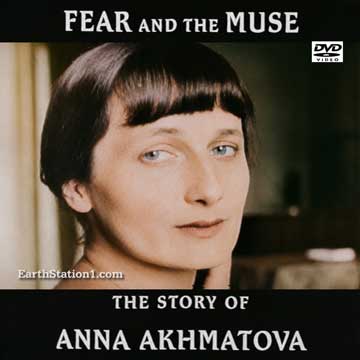
June 23, 1889: #BOTD: #HBD! Anna
Akhmatova, Ukrainian-Russian poet, author and beauty (d. March 5,
1966) is #born Anna Andreyevna Gorenko at Bolshoy Fontan, a resort
suburb of the Black Sea port of Odessa. Known by the pen name Anna
Akhmatova, was one of the most significant poets of the Silver Age
of Russian poetry in the years before and after the turn of the
20th century, and later of the Stalinist years. A celebrated St.
Petersburg beauty known throughout the Russias as the "Queen
Of The Neva", she was held in official disfavour and
persecuted in Soviet Russia for most of the rest of her career,
and was belatedly rehabilitated at the end of her life, becoming
thereby an even more famous and revered Russian artist. She was
shortlisted for the Nobel Prize in 1965 and received second-most
(three) nominations for the award the following year. Akhmatova's
work ranges from short lyric poems to intricately structured
cycles, such as Requiem (1935-40), her tragic masterpiece about
the Stalinist terror. Her style, characterised by its economy and
emotional restraint, was strikingly original and distinctive to
her contemporaries. The strong and clear leading female voice
struck a new chord in Russian poetry. Her writing can be said to
fall into two periods - the early work (1912-25) and her later
work (from around 1936 until her death), divided by a decade of
reduced literary output. Her work was condemned and censored by
Stalinist authorities and she is notable for choosing not to
emigrate, and remaining in Russia, acting as witness to the events
around her. Her perennial themes include meditations on time and
memory, and the difficulties of living and writing in the shadow
of Stalinism. Primary sources of information about Akhmatova's
life are relatively scant, as war, revolution and the Soviet
regime caused much of the written record to be destroyed. For long
periods she was in official disfavour and many of those who were
close to her died in the aftermath of the revolution. Akhmatova's
first husband, Nikolay Gumilyov, was executed by the Soviet secret
police, and her son Lev Gumilyov and her common-law husband
Nikolay Punin spent many years in the Gulag before he died there.
Anna Akhmatova died of heart failure aged 76 at a sanatorium in
Moscow. In November 1965, soon after her visit to Oxford to
receive an honorary doctoral degree, Akhmatova suffered a heart
attack and was hospitalised. She was moved to Domodedovo
Sanitorium, where she eventually died. Thousands attended the two
memorial ceremonies, held in Moscow and in Leningrad. After being
displayed in an open coffin, she was interred at Komarovo Cemetery
in St. Petersburg. Russian-British philosopher and intellectual
historian of ideas Sir Isaiah Berlin (June 6, 1909 - November 5,
1997) said of her passing: "The widespread worship of her
memory in Soviet Union today, both as an artist and as an
unsurrendering human being, has, so far as I know, no parallel.
The legend of her life and unyielding passive resistance to what
she regarded as unworthy of her country and herself, transformed
her into a figure [...] not merely in Russian literature, but in
Russian history in [the twentieth] century." In 1988, to
celebrate what would have been Akhmatova's 100th birthday, Harvard
University held an international conference on her life and work.
Today her work may be explored at the Anna Akhmatova Literary and
Memorial Museum in St. Petersburg. On Sale @ 15% Off Discount Till
Midnight PT!
https://store.earthstation1.com/fear-and-the-muse-the-story-of-anna-akhmatova-dvd.html
Today's
EarthStation1.com 15% Off Commemorative Memorial Title: Minnie The
Moocher And Many Many More DVD, Video Download, Flash Drive
Today, June 23, 2026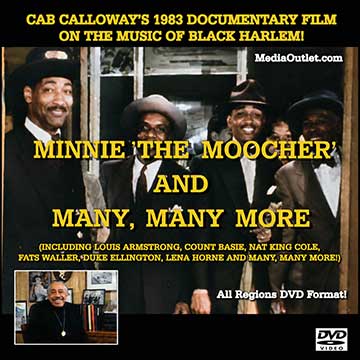
June 23, 1910: #BOTD: #HBD! Milt Hinton,
African American bassist and photographer, nicknamed "Sporty"
from his years in Chicago, "Fump" from his time on the
road with Cab Calloway, and "The Judge" from the 1950s
and beyond, widely regarded as the Dean of jazz bass players (d.
December 19, 2000) is #born Milton John Hintoni n Vicksburg,
Mississippi. After many years with Cab Calloway, Milt Hinton
became a studio musician and appeared with many bands and many tv
and radio shows, working with Louis Armstrong, Count Basie, Jackie
Gleason, Patti Page, Teddy Wilson, Mitch Miller, Dick Cavett,
Billie Holiday, Paul McCartney, Frank Sinatra, Leon Redbone, Sam
Cooke, Barbra Streisand, Andre Kostelanetz, Brook Benton, Johnny
Mathis, Paul Anka, Bobby Rydell and more. Milt Hinton died in
Queens, New York after a long series of ailments at the age of 90.
His burial details are not publicly disclosed. On Sale @ 15% Off
Discount Till Midnight PT!
https://store.earthstation1.com/minnie-the-moocher-and-many-many-more-dvd-1983-cab-call1984.html
Today's
EarthStation1.com 15% Off Commemorative Memorial Title: Breaking
The Code 1996 Alan Turing Derek Jacobi MP4 Video Download DVD
Today, June 23, 2026
June 23, 1912: #BOTD: #HBD! Alan Turing,
English computer scientist, mathematician, logician, cryptanalyst,
philosopher and theoretical biologist (d. June 7, 1954) is #born
Alan Mathison Turing in Maida Vale, London, England. Alan Mathison
Turing OBE FRS was highly influential in the development of
theoretical computer science, providing a formalisation of the
concepts of algorithm and computation with the Turing machine,
which can be considered a model of a general purpose computer.
Turing is widely considered to be the father of theoretical
computer science and artificial intelligence. During the Second
World War, he worked for the Government Code and Cypher School
(GCAndCS) at Bletchley Park, Britain' codebreaking centre that
produced Ultra intelligence. For a time he led Hut 8, the section
which was responsible for German naval cryptanalysis. Here he
devised a number of techniques for speeding the breaking of German
ciphers, including improvements to the pre-war Polish bombe
method, an electromechanical machine that could find settings for
the Enigma machine. Turing played a pivotal role in cracking
intercepted coded messages that enabled the Allies to defeat the
Nazis in many crucial engagements, including the Battle of the
Atlantic, and in so doing helped win the war. Alan Turing died at
his home at Wilmslow, Cheshire, England at the age of 41. On June
8, Alan Mathison Turing OBE FRS's housekeeper found him dead; he
had died the previous day. Cyanide poisoning was established as
the cause of death. When his body was discovered, an apple lay
half-eaten beside his bed, and although the apple was not tested
for cyanide, it was speculated that this was the means by which
Turing had consumed a fatal dose. An inquest determined that he
had committed suicide. Andrew Hodges and another biographer, David
Leavitt, have both speculated that Turing was re-enacting a scene
from the Walt Disney film Snow White and the Seven Dwarfs (1937),
his favourite fairy tale. Both men noted that (in Leavitt's words)
he took "an especially keen pleasure in the scene where the
Wicked Queen immerses her apple in the poisonous brew".
Turing's remains were cremated at Woking Crematorium on June 12,
1954, and his ashes were scattered in the gardens of the
crematorium, just as his father's had been. On Sale @ 15% Off
Discount Till Midnight PT!
https://store.earthstation1.com/breaking-the-code-1996-alan-turing-derek-jacobi-mp4-video-downloa19964.html
Today's
EarthStation1.com 15% Off Commemorative Memorial Title: The
Mexican Revolution 1910-1920 DVD, Video Download, USB Drive
Today, June 23, 2026
June 23, 1914: 20th Century Revolutions:
The Mexican Revolution: The Taking Of Zacatecas: -- Pancho Villa
takes Zacatecas from Victoriano Huerta, breaking the back of the
Huerta regime. Huerta fled the country on July 14, 1914. The
Federal Army collapsed, ceasing to exist as an institution. In
August 1914, Villa's commander Venustiano Carranza and his
revolutionary army entered Mexico City ahead of Villa. Civil war
between these winners was the next stage of the Revolution. Prior
to this victory, Villa successfully captured the strategic prize
of Torreon. Afterwards, Carranza, ordered Villa to break off
action south of Torreon and instead to divert to attack Saltillo.
He threatened to cut off Villa's coal supply, immobilizing his
supply trains, if he did not comply. This was widely seen as an
attempt by Carranza to divert Villa from a direct assault on
Mexico City in order to allow Carranza's forces under Obregon,
driving in from the west via Guadalajara, to take the capital
first. This was an expensive and disruptive diversion for the
Division del Norte. Villa's enlisted men were not unpaid
volunteers but paid soldiers, earning the then enormous sum of one
peso per day. Each day of delay cost thousands of pesos. Disgusted
but having no practical alternative, Villa complied with
Carranza's order and captured the less important city of Saltillo,
and then offered his resignation. Felipe Angeles and the rest of
Villa's staff officers argued for Villa to withdraw his
resignation, defy Carranza's orders, and proceed to attack
Zacatecas, a strategic railroad station heavily defended by
Federal troops and considered nearly impregnable. Since the
colonial era, Zacatecas was the source of much of Mexico's silver,
and thus a supply of funds for whoever held it. Villa accepted his
staff's advice and cancelled his resignation, and the Division del
Norte defied Carranzaand attacked Zacatecas. Attacking up steep
slopes, the Division del Norte defeated the Federals in the Toma
de Zacatecas (Taking Of Zacatecas), the single bloodiest battle of
the Revolution, with Federal casualties numbering approximately
7,000 dead and 5,000 wounded, and unknown numbers of civilian
casualties. A memorial to and museum of the Toma de Zacatecas is
on the Cerro de la Bufa, a key defense point where the Federal
Army was entrenched. On Sale @ 15% Off Discount Till Midnight PT!
https://store.earthstation1.com/the-ragged-revolution-mexican-revolt-191019101920.html
Today's
EarthStation1.com 15% Off Commemorative Memorial Title: Frontiers
Of Flight Aviation History TV Series DVD, MP4, USB Drive
Today, June 23, 2026
June 23, 1931: Aviation: The History Of
Aviation: Aviation Firsts: Circumnavigation: Circumnavigation Of
The Earth: Aerial Circumnavigation Of The Earth: -- Pilot Wiley
Post and Australian navigator Harold Gatty begin their flight to
become the first people to circumnavigate the globe in a
single-engined monoplane aircraft when their Lockheed Vega named
Winnie Mae takes off from Roosevelt Field, Long Island. They
arrived back on July 1, after traveling 15,474 miles (24,903 km)
in the record time of 8 days and 15 hours and 51 minutes, having
stopped at Harbour Grace, Flintshire, Hanover twice, Berlin,
Moscow, Novosibirsk, Irkutsk, Blagoveshchensk, Khabarovsk, Nome
(where his propeller had to be repaired), Fairbanks (where the
propeller was replaced), Edmonton, and Cleveland before returning
to Roosevelt Field. In 1930, the record for flying around the
world was not held by a fixed-wing aircraft, but by the Graf
Zeppelin, piloted by Hugo Eckener in 1929 with a time of 21 days.
The reception they received rivaled Charles Lindbergh's everywhere
they went. They had lunch at the White House on July 7, rode in a
ticker-tape parade the next day in New York City, and were honored
at a banquet given by the Aeronautical Chamber of Commerce of
America at the Hotel Astor. After the flight, Post acquired the
Winnie Mae from F.C. Hall, and he and Gatty published an account
of their journey titled Around the World in Eight Days, with an
introduction by Will Rogers. On Sale @ 15% Off Discount Till
Midnight PT!
https://store.earthstation1.com/frontiers-of-flight-aviation-history-tv-series-dvd-mp4-download-us4.html
Today's
EarthStation1.com 15% Off Commemorative Memorial Title: Paris: The
Outraged City Cities At War WWII France DVD, MP4, USB Drive
Today, June 23, 2026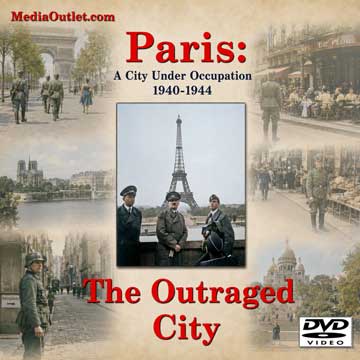
June 23, 1940: The European Civil War:
World War II: The Second European War (The European Theater Of
World War II): The Battle Of France (The Western Campaign [German:
Westfeldzug], The French Campaign [German: Frankreichfeldzug;
French: Campagne De France], The Fall Of France): Fall Rot
(German: "Case Red"): The German Invasion Of Paris: The
German Occupation Of Paris: The Fall Of Paris: Adolf Hitler's Tour
Of Paris: -- Adolf Hitler goes on a gloating three-hour tour of
the architecture of Paris with architect Albert Speer and sculptor
Arno Breker during his only visit to the city. The day after
signing The Second Compiegne Armistice, Adolf Hitler, who was
passionate about architecture and had always wanted to visit
Paris, had a quick visit ("Blitz Besuch") of the city,
accompanied by twho architects Albert Speer and Hermann Giesler,
and Arno Breker, his favorite sculptor, along with a delegation of
military officers and a host of newsreel and still photographers.
The tour began at 6 am and lasted less than 2 1/2 hours. Hitler
and his delegation arrived by plane at Le Bourget airfield, about
12 kms North-East of the entrance of Paris, then Hitler's
motorcade entered the city through the Porte de la Villette. The
streets were near;u empty, as about 2/3 of the Parisians, fearing
massive bombings as the German troops invaded France, has fled the
city to reach the countryside during the exodus of 1940. The group
visited several major monuments, and made a few notable stops:
========= 1: Le Palais Garnier (Opera Garnier): The Fuhrer spent
50 minutes within the halls and rooms of his favorite Parisian
monument, the historic 1,979-seat opera house at the Place de
l'Opera in the 9th arrondissement of Paris, and made it the first
place he wanted to visit. Albert Speer recalled "The great
stairway, the resplendent foyer, the elegant, gilded parterre,
were carefully inspected. All the lights glowed as they would on a
gala night. Hitler had undertaken to lead the party. Hitler had
actually studied the plans of the Paris opera house with great
care. Near the proscenium box he found a salon missing, remarked
on it, and turned out to be right. The attendant said that this
room had been eliminated in the course of renovations many years
ago. He seemed fascinated by the Opera, went into ecstasies about
its beauty, his eyes glittering with an excitement that struck me
as uncanny." ========= 2: L'Eglise Sainte-Marie-Madeleine:
The convoy made a stop at The Church of Sainte-Marie-Madeleine (La
Madeleine), a Catholic parish church on Place de la Madeleine in
the 8th arrondissement of Paris that resembles the Parthenon, but
did not stay long, as the building did not impress Hitler very
much. ========= 3: L'Arc De Triomphe: The cars then took the
direction of Place de la Concorde, and made a brief stop down the
Avenue des Champs Elysees, where Hitler admired the view and
perspective of the avenue before going further up to the Arc de
Triomphe. The group stopped under the monument and stayed a brief
moment in front of the unknown's soldier's tomb, which is just
under the Arc de Triomphe. ========= 4: Le Trocadero / Tour
Eiffel: On the Esplanade du Trocadero, a large place in front of
the Eiffel Tower, just on the other side of the River Seine, the
group admired the view on the tower, and several well known
photographs were taken as propaganda material of Hitler's victory
over France and Western Europe. Afterwards, the cars drove towards
the Eiffel Tower, and along the Champ de Mars to the Ecole
Militaire (military academy) and the statue of marshall Joffre.
They were not able to go into the Eiffel Tower because the French
had severed the lift cables just before the German invasion.
========= 5 Les Invalides / Le Tombeau De Napoleon: The second
monument that Hitler did not want to miss was The Hotel des
Invalides, a complex of buildings in the 7th arrondissement of
Paris, France, containing museums and monuments, all relating to
the military history of France, as well as a hospital and an Old
Soldiers' retirement home, the building's original purpose. The
buildings house the Musee de l'Armee, the military museum of the
Army of France, the Musee des Plans-Reliefs, and the Musee
d'Histoire Contemporaine. The complex also includes the former
hospital chapel, now national cathedral of the French military,
and the adjacent former Royal Chapel known as the Dome des
Invalides, the tallest church building in Paris at a height of 107
meters. The latter has been converted into a shrine of some of
France's leading military figures, most notably the tomb of
Napoleon. Hitler wanted to and did stay a moment in front of
Napoleon's tomb, a character that he admired for his military and
strategic talents. In this way, Hitler was mirroring Napoleon's
similar visit in 1806, after his successful campaign over Prussia,
to the tomb of king Frederick the Great in Potsdam. ========= 6:
Le Pantheon: After passing in front of the Assemblee Nationale,
the convoy headed toward the the Jardins du Luxembourg and took
south to have a view of the Place de l'Observatoire (Paris
observatory) and the statue of Marshall Ney before going north to
the Pantheon, a monument dedicated to the greatest French men and
women in the 5th arrondissement of Paris, France in the Latin
Quarter (Quartier latin) atop the Montagne Sainte-Genevieve, in
the centre of the Place du Pantheon, which was named after it.
According to Albert Speer, the architecture and size of the
building impressed Hitler very much. ========= 7: La Basilique du
Sacre-Coeur (The Basilica Of The Sacred Heart): The cars then took
North and passed in front of the Palais de Justice with the
Sainte-Chapelle, and Notre-Dame cathedral on the Ile de la cite.
They crossed the river Seine to the right bank and passed beside
the Place des Vosges, rue de Rivoli and the Louvres museum. In his
memoirs, Albert Speer recalls that Hitler did not find any
particular interest to the most beautiful architectural works of
the city. The final place of the visit was the Sacre-Coeur
basilica on Montmartre (a hill with a view on all Paris). Hitler
did not like the church at all, but he and his men enjoyed the
view. ========= The convoy then left the city and headed back to
the Bourget airfield, from where Hitler flew back to his
Wolfsschlucht headquarters, never to go to Paris again. =========
This tour of Paris seems to have inspired Hitler to resume the
construction of Germania in Berlin, a massive architectural
project to replace Berlin with gigantic military, administrative
and political buildings and create the biggest city in the world,
which had stopped at the outbreak of the war. Albert Speer
recalls: "That same evening he received me once more in the
small room in the peasant house. He was sitting alone at table.
Without more ado he declared: 'Draw up a decree in my name
ordering full-scale resumption of work on the Berlin buildings.
Wasn't Paris beautiful? But Berlin must be made far more
beautiful. In the past I often considered whether we would not
have to destroy Paris,' he continued with great calm, as if he
were talking about the most natural thing in the world. 'But when
we are finished in Berlin, Paris will only be a shadow. So why
should we destroy it?' With that, I was dismissed." On Sale @
15% Off Discount Till Midnight PT!
https://store.earthstation1.com/paris-the-outraged-city-dvd-cities-at-war-wwii-france.html
Today's
EarthStation1.com 15% Off Commemorative Memorial Title: Auschwitz
And The Allies 2 Part TV Series DVD, Download, USB Drive
Today, June 23, 2026
June 23, 1942: The European Civil War:
World War II: The Second European War (The European Theater Of
World War II): The Holocaust (Shoah): The Holocaust In Poland:
Auschwitz Concentration Camp (KL Auschwitz, KZ Auschwitz): -- The
first selections for the gas chamber at Auschwitz concentration
camp take place on a train full of Jews from Paris, France.
Auschwitz concentration camp was a network of concentration and
extermination camps built and operated by Nazi Germany in occupied
Poland during World War II. It consisted of Auschwitz I (the
original concentration camp), Auschwitz II-Birkenau (a combination
concentration/extermination camp), Auschwitz III-Monowitz (a labor
camp to staff an IG Farben factory), and 45 satellite camps.
Auschwitz I was first constructed to hold Polish political
prisoners, who began to arrive in May 1940. The first
extermination of prisoners took place in September 1941. Auschwitz
II-Birkenau went on to become a major site of the Nazis' Final
Solution to the Jewish Question during the Holocaust. From early
1942 until late 1944, transport trains delivered Jews to the
camp's gas chambers from all over German-occupied Europe, where
they were killed en masse with the cyanide-based poison Zyklon B,
originally developed to be used as a pesticide. An estimated 1.3
million people were sent to the camp, of whom at least 1.1 million
died. Around 90 percent of those were Jews; approximately one in
six Jews killed in the Holocaust died at the camp. Others deported
to Auschwitz included 150,000 Poles, 23,000 Romani and Sinti,
15,000 Soviet prisoners of war, 400 Jehovah's Witnesses, and tens
of thousands of others of diverse nationalities, including an
unknown number of homosexuals. Many of those not killed in the gas
chambers died of starvation, forced labor, infectious diseases,
individual executions, and medical experiments. In the course of
the war, the camp was staffed by 7,000 members of the German
Schutzstaffel (SS), approximately 12 percent of whom were later
convicted of war crimes. Some, including camp commandant Rudolf
Hoss, were executed. The Allied Powers did not act on early
reports of atrocities at the camp, and their failure to bomb the
camp or its railways remains controversial. At least 802 prisoners
attempted to escape from Auschwitz, 144 successfully, and on 7
October 1944 two Sonderkommando units - prisoners assigned to
staff the gas chambers - launched a brief, unsuccessful uprising.
As Soviet troops approached Auschwitz in January 1945, most of its
population was sent west on a death march. The prisoners remaining
at the camp were liberated on 27 January 1945, a day now
commemorated as International Holocaust Remembrance Day. In the
following decades, survivors such as Primo Levi, Viktor Frankl,
and Elie Wiesel wrote memoirs of their experiences in Auschwitz,
and the camp became a dominant symbol of the Holocaust. In 1947
Poland founded the Auschwitz-Birkenau State Museum on the site of
Auschwitz I and II, and in 1979 it was named a World Heritage Site
by UNESCO. On Sale @ 15% Off Discount Till Midnight PT!
https://store.earthstation1.com/auschwitz-and-the-allies-dvd-complete-2-part-tv-serie2.html
Today's
EarthStation1.com 15% Off Commemorative Memorial Title: Portraits
Of The Presidency: POTUS Documentaries DVD, Download, USB
Today, June 23, 2026
June 23, 1947: Organized Labor: The Labor
Union Movement: The Labor History Of The United States: Labor
Unions In The United States: Trade Union Legislation: The
Taft-Hartley Act (The Labor Management Relations Act of 1947): --
The United States Senate follows the United States House Of
Representatives in overriding U.S. President Harry Truman's veto
of the Taft-Hartley Act. a United States federal law that
restricts the activities and power of labor unions. The act, still
effective, was sponsored by Senator Robert A. Taft and
Representative Fred A. Hartley, Jr., and became law despite U.S.
President Harry S. Truman's veto on June 23, 1947. Labor leaders
called it the "slave-labor bill" while President Truman
argued that it was a "dangerous intrusion on free speech",
arguing that it would "conflict with important principles of
our democratic society". Nevertheless, after it passed,
Truman relied upon it in twelve instances during his presidency.
The Taft-Hartley Act amended the National Labor Relations Act
(NLRA; informally the Wagner Act), which Congress passed in 1935.
The principal author of the Taft-Hartley Act was J. Mack Swigert,
of the Cincinnati law firm Taft, Stettinius and Hollister.
Historian James T. Patterson concludes that "By the 1950s
most observers agreed that Taft-Hartley was no more disastrous for
workers than the Wagner Act had been for employers. What
ordinarily mattered most in labor relations was not government
laws such as Taft-Hartley, but the relative power of unions and
management in the economic marketplace. Where unions were strong
they usually managed all right; when they were weak, new laws did
them little additional harm." On Sale @ 15% Off Discount Till
Midnight PT!
https://store.earthstation1.com/portraits-of-the-presidency-roosevelt-wilson-hoover-taft-willkie.html
Today's
EarthStation1.com 15% Off Commemorative Memorial Title: Clarence
Thomas And Anita Hill Public Hearing Private Pain DVD MP4 USB
Today, June 23, 2026
June 23, 1948: #BOTD: Clarence Thomas,
African American lawyer, Associate Justice of the Supreme Court of
the United States, is #born in his parents' wooden shack in Pin
Point, Georgia, a small community near Savannah founded by
freedmen in the 1880s. He was nominated by President George H. W.
Bush to succeed Thurgood Marshall and has served since 1991. After
Marshall, Thomas is the second African American to serve on the
Supreme Court and has been its longest-serving member since
Anthony Kennedy's retirement in 2018. Since Stephen Breyer's
retirement in 2022, he is also the Court's oldest member. After
his father abandoned the family, he was raised by his grandfather
in a poor Gullah community near Savannah. Growing up as a devout
Catholic, Thomas originally intended to be a priest in the
Catholic Church but was frustrated over the church's insufficient
attempts to combat racism. He abandoned his aspiration of becoming
a clergyman to attend the College of the Holy Cross and Yale Law
School, where he was influenced by a number of conservative
authors, notably Thomas Sowell. Upon graduating, he was appointed
as an assistant attorney general in Missouri and later entered
private practice there. He became a legislative assistant to U.S.
Senator John Danforth in 1979, and was made Assistant Secretary
for Civil Rights at the U.S. Department of Education in 1981.
President Ronald Reagan appointed Thomas as Chairman of the Equal
Employment Opportunity Commission (EEOC) the next year. President
George H. W. Bush nominated Thomas to the United States Court of
Appeals for the District of Columbia Circuit in 1990. He served in
that role for 19 months before filling Marshall's seat on the
Supreme Court. Thomas's confirmation hearings were bitter and
intensely fought, centering on an accusation that he had sexually
harassed Anita Hill, a subordinate at the Department of Education
and the EEOC. Hill alleged that Thomas made multiple inappropriate
sexual and romantic overtures to her; Thomas and his supporters
alleged that Hill and her political supporters had fabricated the
accusation to prevent the appointment of a black conservative. The
Senate confirmed Thomas by a vote of 52-48, the narrowest margin
in a century. Since the death of Antonin Scalia, Thomas has been
the Court's foremost originalist, stressing the original meaning
in interpreting the Constitution. In contrast to Scalia -- who had
been the only other consistent originalist -- he pursues a more
classically liberal variety of originalism. He also supported
ideas of natural law before becoming a judge. Thomas was known for
his silence during most oral arguments, though has since begun
asking more questions to counsel. He is notable for his majority
opinions in Good News Club v. Milford Central School (determining
the freedom of religious speech in relation to the First
Amendment) and New York State Rifle & Pistol Association, Inc.
v. Bruen (affirming the individual right to bear arms outside the
home), as well as his dissent in Gonzales v. Raich (arguing that
Congress may not criminalize the private cultivation of medical
marijuana). He is widely considered to be the Court's most
conservative member. On Sale @ 15% Off Discount Till Midnight PT!
https://store.earthstation1.com/clarence-thomas-and-anita-hill-public-hearing-private-pain-dvd-mp4-us4.html
Today's
EarthStation1.com 15% Off Commemorative Memorial Title: Elvis
Presley Documentaries Set MP4 Video Download DVD
Today, June 23, 2026
June 23, 1957: Disease: The History Of
Disease: Infectious Diseases (Transmissible Diseases, Communicable
Diseases): Polio (Poliomyelitis): Vaccines: Polio Vaccines The IPV
Polio Vaccine (The Inactivated Polio Vaccine, The Salk Vaccine):
-- On the 42nd birthday of Jonas Salk, the American biologist and
physician who discovered and developed one of the first successful
polio vaccines, Elvis Presley received a polio vaccination on
national TV. This single event is credited with raising
immunization levels in the United States from 0.6% to over 80% in
just six months. On April 12, 1955, the inactivated polio vaccine
he developed was declared safe and effective. The first successful
demonstration of a polio vaccine was by Hilary Koprowski in 1950,
with a live attenuated virus which people drank. This vaccine,
however, was not approved in the United States. An inactivated
polio vaccine, developed a few years later by Jonas Salk, came
into use in 1955. Another oral polio vaccine was developed by
Albert Sabin and came into commercial use in 1961. It is on the
World Health Organization's List of Essential Medicines, the
safest and most effective medicines needed in a health system.
Polio vaccines are vaccines used to prevent poliomyelitis (polio).
Two types are used: an inactivated poliovirus given by injection
(IPV) and a weakened poliovirus given by mouth (OPV). The World
Health Organization (WHO) recommends all children be fully
vaccinated against polio. The two vaccines have eliminated polio
from most of the world, and reduced the number of cases reported
each year from an estimated 350,000 in 1988 to 33 in 2018. The
inactivated polio vaccines are very safe. Mild redness or pain may
occur at the site of injection. Oral polio vaccines cause about
three cases of vaccine-associated paralytic poliomyelitis per
million doses given. This compares with 5,000 cases per million
who are paralysed following a polio infection. Both are generally
safe to give during pregnancy and in those who have HIV/AIDS but
are otherwise well. The wholesale cost in the developing world is
about 0.25 USD per dose for the oral form as of 2014. In the
United States, it costs between 25-50 USD for the inactivated
form. On Sale @ 15% Off Discount Till Midnight PT!
https://store.earthstation1.com/viva-elvis-dvd-elvis-presley-cult-documentary.html
Today's
EarthStation1.com 15% Off Commemorative Memorial Title: The Red
Bomb Soviet Nuclear Bombs History + 2 Bonuses MP4 Download DVD
Today, June 23, 2026
June 23, 1959: The Aftermath Of World War
II: The Cold War: Nuclear Espionage: Soviet Nuclear Espionage:
Atomic Spies: Klaus Fuchs: -- German theoretical physicist Klaus
Fuchs, convicted Manhattan Project atomic spy and traitor, is
released after only nine years in prison and allowed to emigrate
to Dresden, East Germany where he resumes a scientific career. On
March 1, 1950, after The Trial Of Klaus Fuchs, Emil Julius Klaus
Fuchs (December 29, 1911 - January 28, 1988) was convicted of
supplying information from the American, British, and Canadian
Manhattan Project to the Soviet Union during and shortly after the
Second World War. While at the Los Alamos National Laboratory,
Fuchs was responsible for many significant theoretical
calculations relating to the first nuclear weapons, and later,
early models of the hydrogen bomb. On October 18, 1945, the USSR's
nuclear program received plans for the United States plutonium
bomb from Klaus Fuchs at the Los Alamos National Laboratory. On
Sale @ 15% Off Discount Till Midnight PT!
https://store.earthstation1.com/the-red-bomb-soviet-nuclear-weapons-history-tv-series-mp4-download-dv4.html
Today's
EarthStation1.com 15% Off Commemorative Memorial Title: Making
Sense Of The Sixties TV Series DVD, Video Download, USB Drive
Today, June 23, 2026
June 23, 1960: Counterculture Of The
1960s: The Sexual Revolution (The Sexual Liberation Movement):
Reproductive Rights: Reproductive Rights In The United States:
Birth Control (Contraception, Anticonception, Fertility Control):
-- The United States Food And Drug Administration (FDA) declares
Enovid to be the first officially approved combined oral
contraceptive pill in the world. Mestranol/Norethynodrel was the
first combined oral contraceptive pill (COCP) being mestranol and
norethynodrel. Known colloquially as "The Pill", it was
sold as Enovid in the United States and as Enavid in the United
Kingdom. Developed by Gregory Pincus at G. D. Searle &
Company, it was first approved on June 10, 1957 by the U.S. Food
and Drug Administration for treatment of menstrual disorders. The
FDA approved an additional indication for use as a contraceptive
on June 23, 1960, though it only became legally prescribable
nationwide and regardless of the woman's marital status after
Eisenstadt v. Baird in 1972. In 1961, it was approved as a
contraceptive in the UK and in Canada. It was a harbinger of The
Sexual Revolution, also known as a time of sexual liberation, and
was part of a broad social movement that challenged traditional
codes of behavior related to sexuality and interpersonal
relationships throughout the United States and subsequently, the
wider world, from the 1960s to the 1980s. Sexual liberation
included increased acceptance of sex outside of traditional
heterosexual, monogamous relationships (primarily marriage). The
normalization of contraception and the pill, public nudity,
pornography, premarital sex, homosexuality, masturbation,
alternative forms of sexuality, and the legalization of abortion
all followed. On Sale @ 15% Off Discount Till Midnight PT!
https://store.earthstation1.com/making-sense-of-the-sixties-tv-documentary-series-6-hour-episode6.html
Today's
EarthStation1.com 15% Off Commemorative Memorial Title: War And
Peace In The Nuclear Age TV Series DVD, Download, USB Drive
Today, June 23, 2026
June 23, 1967: The Aftermath Of World War
II: The Cold War: Arms Control: Nuclear Arms Control: The
Glassboro Summit Conference (The Glassboro Summit): -- U.S.
President Lyndon B. Johnson meets with Soviet Premier Alexei
Kosygin in Glassboro, New Jersey for the three-day Glassboro
Summit Conference. Usually just called the Glassboro Summit, it
was the 23-25 June 1967 meeting of the heads of government of the
United States and the Soviet Union-President Lyndon B. Johnson and
Premier Alexei Kosygin, respectively-for the purpose of discussing
Soviet Union-United States relations in Glassboro, New Jersey.
During the Arab-Israeli Six-Day War diplomatic contact and
cooperation increased, leading some to hope for an improvement in
the two countries' relations. Some even hoped for joint
cooperation on the Vietnam War. Although Johnson and Kosygin
failed to reach agreement on anything important, the generally
amicable atmosphere of the summit was referred to as the "Spirit
of Glassboro" and is seen to have improved Soviet-US
relations. On Sale @ 15% Off Discount Till Midnight PT!
https://store.earthstation1.com/war-and-peace-in-the-nuclear-age-dvd-set-tv-series-7-disc7.html
Today's
EarthStation1.com 15% Off Commemorative Memorial Title: The
Machine That Changed The World The Computer + Bonus 3 MP4s Or DVDs
Today, June 23, 2026
June 23, 1969: The Industrial Revolution:
The Third Industrial Revolution (1947-Present) (The Information
Age, The Computer Age, The Digital Age, The Digital Electronics
Revolution, The Silicon Age, The New Media Age, The Media Age):
The Computer: The History Of The Computer: Digital Computers: The
History Of Software: -- IBM announces that effective January 1970
it will price its software and services separately from hardware,
a decision that ultimately creates the modern software industry.
The Software Industry includes businesses for development,
maintenance and publication of software that are using different
business models, mainly either "license/maintenance based"
(on-premises) or "Cloud based" (such as SaaS, PaaS,
IaaS, MBaaS, MSaaS, DCaaS etc.). The industry also includes
software services, such as training, documentation, consulting and
data recovery. The software and computer services industry spends
more than 11% of its net sales for Research & Development
which is in comparison with other industries the second highest
share after pharmaceuticals & biotechnology. On Sale @ 15% Off
Discount Till Midnight PT!
https://store.earthstation1.com/the-machine-that-changed-the-world-the-computer-dvd-mp4-downloa4.html
Today's
EarthStation1.com 15% Off Commemorative Memorial Title: Adam
Clayton Powell Biography + 2 Bonus Titles DVD MP4 Video Download
Today, June 23, 2026
June 23, 1970: Elections: Elections In
The United States: The 1970 United States House Of Representatives
Elections: -- Charles Rangel defeats Adam Clayton Powell in
Harlem's Democratic primary election in New York's 18th
congressional district by 150 votes out of around 25,000 cast,
bringing to an end the political career of one of the leading
African American political symbols of the post-World War II
period. Long-time incumbent Congressman Adam Clayton Powell Jr.
had been an iconic, charismatic and flamboyant figure, who had
become embroiled in an ethics controversy in 1967, lost his seat,
and then regained it in 1969 due to the U.S. Supreme Court
decision in Powell v. McCormack. In a field with five candidates,
Rangel focused on criticizing Powell's frequent and increasing
absences from Congress, absences that had been well noted by his
constituents. Powell tried to take legal action to overturn the
primary results, claiming over 1,000 ballots were improper votes,
but was unsuccessful. Powell also failed to get enough signatures
for inclusion on the November ballot as an Independent candidate.
With both Democratic and Republican backing, Rangel won the
November 1970 general election, against a Liberal Party candidate
and several others, with a resounding 88 percent of the vote.
Powell moved to his retreat on Bimini in The Bahamas in the fall
of 1970, also resigning as minister at the Abyssinian Baptist
Church. Rangel went on to win consecutive re-elections and
continuously serve as a U.S. representative for districts in New
York City from 1971 to 2017. On Sale @ 15% Off Discount Till
Midnight PT!
https://store.earthstation1.com/adam-clayton-powell-documentary-biography.html
Today's
EarthStation1.com 15% Off Commemorative Memorial Title: The Final
Days: Richard Nixon TV Docudrama DVD, Download, USB Drive
Today, June 23, 2026
June 23, 1972: Scandals: Political
Scandals: Political Scandals Of The United States: Richard Nixon:
The Presidency Of Richard Nixon: The Watergate Scandal: The Nixon
White House Tapes: The Smoking Gun Tape: -- U.S. President Richard
M. Nixon and White House Chief Of Staff H. R. Haldeman are taped
talking about using the Central Intelligence Agency to obstruct
the Federal Bureau of Investigation's investigation into the
Watergate break-ins. The conversation took place from 10:04 AM to
11:39 AM. The recording subsequently became known as the Smoking
Gun, and led directly to Nixon's resignation. President Nixon
released the tape on August 5. It was one of three conversations
he had with Haldeman six days after the Watergate break-in. The
tapes prove that he ordered a cover-up of the Watergate burglary.
The Smoking Gun tape reveals that Nixon ordered the FBI to abandon
its investigation of the break-in. After the release of the tape,
the eleven Republicans on the Judiciary Committee who voted
against impeachment charges said they would change their votes. It
was clear that Nixon would be impeached and convicted in the
Senate. Nixon announced his resignation on August 8. On Sale @ 15%
Off Discount Till Midnight PT!
https://store.earthstation1.com/the-final-days-dvd-1989-pres-nixon-resignation-docudrama-2-dis19892.html
Today's
EarthStation1.com 15% Off Commemorative Memorial Title: The
Yellowstone Fires Of 1988 Documentary DVD, Download, USB Drive
Today, June 23, 2026
June 23, 1988: Natural Disasters: Natural
Disasters In The United States: Wildfires (Forest Fires,
Bushfires, Brushfires, Wildland Fires, Rural Fires): The
Yellowstone Fires Of 1988: The Shoshone Fire: -- The largest fire
in the large group of fires known as the Snake River Complex, The
Shoshone Fire, is started by lightning. These fires were in the
southern section of the park, in the headwaters region of the
Yellowstone and Snake Rivers. Because prescribed natural burn
policy were still in effect, at first no efforts were made to
suppress this fire. It smoldered with little movement for several
weeks, then rapidly started expanding towards the northeast on
July 20. The Red Fire, started near Lewis Lake on July 1, advanced
little for several weeks like the Shoshone fire had. The Red Fire
then moved northeast on July 19, and combined with the Shoshone
Fire in August. As these two fires advanced towards the Grant
Village area, evacuations were ordered so fire fighting crews
could concentrate on structure protection. In the midst of a large
lodgepole pine forest, the Grant Village complex was the first
major tourist area impacted that season. A number of small
structures and some of the campground complex were destroyed.
After the Red Fire and Shoshone Fire combined, they were referred
to collectively as the Shoshone Fire, since it was much larger.
The Yellowstone Fires Of 1988 (June 14 - November 18, 1988)
started as many smaller individual fires. The flames quickly
spread out of control due to drought conditions and increasing
winds, combining into one large conflagration which burned for
several months. The fires almost destroyed two major visitor
destinations and, on September 8, 1988, the entire park closed to
all non-emergency personnel for the first time in its history.
Only the arrival of cool and moist weather in the late autumn
brought the fires to an end. A total of 793,880 acres (3,213 km2),
or 36 percent of the park, was affected by the wildfires.
Thousands of firefighters fought the fires, assisted by dozens of
helicopters and fixed-wing aircraft which were used for water and
fire retardant drops. At the peak of the effort, more than 9,000
firefighters were assigned to the park. With fires raging
throughout the Greater Yellowstone Ecosystem and other areas in
the western United States, the staffing levels of the National
Park Service and other land management agencies were inadequate
for the situation; more than 4,000 U.S. military personnel were
soon brought in to assist in wildfire suppression efforts. The
firefighting effort cost 120M USD (260M USD in 2021). Losses to
structures were minimized by concentrating firefighting efforts
near major visitor areas, keeping property damage down to 3M USD
(7M USD as of 2021). No firefighters died while fighting the
Yellowstone fires, though there were two fire-related deaths
outside the park. Before the late 1960s, fires were generally
believed to be detrimental for parks and forests, and management
policies were aimed at suppressing fires as quickly as possible.
However, as the beneficial ecological role of fire became better
understood in the decades before 1988, a policy was adopted of
allowing natural fires to burn under controlled conditions, which
proved highly successful in reducing the area lost annually to
wildfires. The unprecedented nature of the fires led to many
questions about existing fire management policies. Media accounts
of mismanagement were often sensational and inaccurate, sometimes
wrongly reporting or implying that most of the park was being
destroyed. While there were temporary declines in air quality
during the fires, no adverse long-term health effects have been
recorded in the ecosystem and, contrary to initial reports, few
large mammals were killed by the fires, though there was a
subsequent reduction in the number of moose which has yet to
rebound. On Sale @ 15% Off Discount Till Midnight PT!
https://store.earthstation1.com/the-yellowstone-fires-of-1988-documentary1988.html
Today's
EarthStation1.com #OnThisDay Commemorative Memorial Title: War
Props: The Focke-Wulf Fw 190 Shrike DVD MP4 Download USB Drive
Today, June 23, 2026 June 23, 1942: The European Civil War:
World War II: The Second European War (The European Theater Of
World War II): Air Warfare Of World War II: -- Germany's latest
fighter aircraft, Focke-Wulf Fw 190 Wuerger ("Shrike")
fighter-bomber airplane, is captured intact when it mistakenly
lands at RAF Pembrey in Wales. It was a German single-seat,
single-engine fighter aircraft designed by Kurt Tank in the late
1930s and widely used during World War II. Along with its
well-known counterpart, the Messerschmitt Bf 109, the Fw 190
became the backbone of the Luftwaffe's Jagdwaffe (Fighter Force).
The twin-row BMW 801 radial engine that powered most operational
versions enabled the Fw 190 to lift larger loads than the Bf 109,
allowing its use as a day fighter, fighter-bomber, ground-attack
aircraft and, to a lesser degree, night fighter. The Fw 190A
started flying operationally over France in August 1941, and
quickly proved superior in all but turn radius to the Royal Air
Force's main front-line fighter, the Spitfire Mk. V, particularly
at low and medium altitudes. The 190 maintained superiority over
Allied fighters until the introduction of the improved Spitfire
Mk. IX. In November/December 1942, the Fw 190 made its air combat
debut on the Eastern Front, finding much success in fighter wings
and specialised ground attack units called Schlachtgeschwader
(Battle Wings or Strike Wings) from October 1943 onwards. The Fw
190 provided greater firepower than the Bf 109, and at low to
medium altitude, superior manoeuvrability, in the opinion of
German pilots who flew both fighters. The Fw 190A series'
performance decreased at high altitudes (usually 6,000 m (20,000
ft) and above), which reduced its effectiveness as a high-altitude
interceptor. From the Fw 190's inception, there had been ongoing
efforts to address this with a turbosupercharged BMW 801 in the B
model, the much longer-nosed C model with efforts to also
turbocharge its chosen Daimler-Benz DB 603 inverted V12
powerplant, and the similarly long-nosed D model with the Junkers
Jumo 213. Problems with the turbocharger installations on the -B
and -C subtypes meant only the D model would enter service, doing
so in September 1944. While these "long nose" versions
gave the Germans parity with Allied opponents, they arrived far
too late in the war to have any real effect. The Fw 190 was
well-liked by its pilots. Some of the Luftwaffe's most successful
fighter aces claimed a great many of their kills while flying it,
including Otto Kittel, Walter Nowotny and Erich Rudorffer.
https://store.earthstation1.com/war-props-the-fockewulf-fw-190-dvd-mp4-download1904.html
June 23, 1942: The European Civil War:
World War II: The Second European War (The European Theater Of
World War II): Air Warfare Of World War II: -- Germany's latest
fighter aircraft, Focke-Wulf Fw 190 Wuerger ("Shrike")
fighter-bomber airplane, is captured intact when it mistakenly
lands at RAF Pembrey in Wales. It was a German single-seat,
single-engine fighter aircraft designed by Kurt Tank in the late
1930s and widely used during World War II. Along with its
well-known counterpart, the Messerschmitt Bf 109, the Fw 190
became the backbone of the Luftwaffe's Jagdwaffe (Fighter Force).
The twin-row BMW 801 radial engine that powered most operational
versions enabled the Fw 190 to lift larger loads than the Bf 109,
allowing its use as a day fighter, fighter-bomber, ground-attack
aircraft and, to a lesser degree, night fighter. The Fw 190A
started flying operationally over France in August 1941, and
quickly proved superior in all but turn radius to the Royal Air
Force's main front-line fighter, the Spitfire Mk. V, particularly
at low and medium altitudes. The 190 maintained superiority over
Allied fighters until the introduction of the improved Spitfire
Mk. IX. In November/December 1942, the Fw 190 made its air combat
debut on the Eastern Front, finding much success in fighter wings
and specialised ground attack units called Schlachtgeschwader
(Battle Wings or Strike Wings) from October 1943 onwards. The Fw
190 provided greater firepower than the Bf 109, and at low to
medium altitude, superior manoeuvrability, in the opinion of
German pilots who flew both fighters. The Fw 190A series'
performance decreased at high altitudes (usually 6,000 m (20,000
ft) and above), which reduced its effectiveness as a high-altitude
interceptor. From the Fw 190's inception, there had been ongoing
efforts to address this with a turbosupercharged BMW 801 in the B
model, the much longer-nosed C model with efforts to also
turbocharge its chosen Daimler-Benz DB 603 inverted V12
powerplant, and the similarly long-nosed D model with the Junkers
Jumo 213. Problems with the turbocharger installations on the -B
and -C subtypes meant only the D model would enter service, doing
so in September 1944. While these "long nose" versions
gave the Germans parity with Allied opponents, they arrived far
too late in the war to have any real effect. The Fw 190 was
well-liked by its pilots. Some of the Luftwaffe's most successful
fighter aces claimed a great many of their kills while flying it,
including Otto Kittel, Walter Nowotny and Erich Rudorffer.
https://store.earthstation1.com/war-props-the-fockewulf-fw-190-dvd-mp4-download1904.html
Today's
EarthStation1.com #OnThisDay Commemorative Memorial Title: The
Nobel Century Nobel Prize History TV Series DVD, MP4, USB Stick
Today, June 23, 2026June 23, 1995: #DOTD: #RIP: Jonas Salk,
American biologist and physician (b. October 28, 1914) #dies of
heart failure at the age of 80 in La Jolla, California. He is
buried at El Camino Memorial Park in San Diego. He discovered and
developed one of the first successful polio vaccines. Jonas Salk
was born into an Ashkenazi Jewish family in New York City. On
Salk's 42nd birthday (June 23, 1957), Elvis Presley received a
polio vaccination on national TV. This single event is credited
with raising immunization levels in the United States from 0.6% to
over 80% in just six months. On April 12, 1955, the inactivated
polio vaccine he developed was declared safe and effective. The
first successful demonstration of a polio vaccine was by Hilary
Koprowski in 1950, with a live attenuated virus which people
drank. This vaccine, however, was not approved in the United
States. An inactivated polio vaccine, developed a few years later
by Jonas Salk, came into use in 1955. Another oral polio vaccine
was developed by Albert Sabin and came into commercial use in
1961. It is on the World Health Organization's List of Essential
Medicines, the safest and most effective medicines needed in a
health system. Polio vaccines are vaccines used to prevent
poliomyelitis (polio). Two types are used: an inactivated
poliovirus given by injection (IPV) and a weakened poliovirus
given by mouth (OPV). The World Health Organization (WHO)
recommends all children be fully vaccinated against polio. The two
vaccines have eliminated polio from most of the world, and reduced
the number of cases reported each year from an estimated 350,000
in 1988 to 33 in 2018. The inactivated polio vaccines are very
safe. Mild redness or pain may occur at the site of injection.
Oral polio vaccines cause about three cases of vaccine-associated
paralytic poliomyelitis per million doses given. This compares
with 5,000 cases per million who are paralysed following a polio
infection. Both are generally safe to give during pregnancy and in
those who have HIV/AIDS but are otherwise well. The wholesale cost
in the developing world is about 0.25 USD per dose for the oral
form as of 2014. In the United States, it costs between 25-50 USD
for the inactivated form. Salk's not recieving the Nobel Prize for
his vaccine is considered one of history's biggest Nobel prize
snubs. Although Salk never received a Nobel Prize for his work,
the Salk Institute for Biological Studies in La Jolla, Calif. has
trained five Nobel Laureates. It is left to speculation as to why
nominations highlighting the contributions of scientists such as
Jonas Salk, Hilary Koprowski, and Albert Sabin in the development
of poliovirus vaccines have not been recognized by a Nobel Prize.
https://store.earthstation1.com/the-nobel-century-nobel-prize-history-tv-series-dvd-mp4-us4.html
Today's
EarthStation1.com #OnThisDay Commemorative Memorial Title: Greek
Fire: Ancient Greece In Today's World TV Series DVD, MP4, USB
Today, June 23, 2026June 23, 1996: #DOTD: Andreas Papandreou,
Greek economist, politician and a dominant figure in Greek
politics, founder of the political party PASOK which he led from
1974 to 1996, 174th Prime Minister of Greece (b. 5 February 1919)
#dies in Athens, Greece, aged 77. He is buried at Athens First
Cemetery in Athens, Greece. Born Andreas Georgiou Papandreou in
Chios, Greece, he served three terms as the 3rd and 8th prime
minister of Greece. Papandreou's party win in the 1981 election
was a milestone in the political history of Greece, since it was
the first time that the elected government had a predominantly
socialist political program. The achievements of his first two
governments include the official recognition of the leftist and
communist resistance groups of the Greek Resistance (EAM/ELAS)
against the Axis occupation, the establishment of the National
Health System and the Supreme Council for Personnel Selection
(ASEP), the passage of Law 1264/1982 which secured the right to
strike and greatly improved the rights of workers, the
constitutional amendment of 1985-1986 which strengthened
parliamentarism and reduced the powers of the indirectly-elected
president, the conduct of an assertive and independent Greek
foreign policy, the expansion in the power of local governments,
many progressive reforms in Greek law and the granting of
permission to the refugees of the Greek Civil War, of Greek
ethnicity, to return home in Greece. The Panhellenic Socialist
Movement (PASOK), which he founded and led, was the first
non-communist political party in Greek history with a mass-based
organization, introducing an unprecedented level of political and
social participation in Greek society. In a poll conducted by
Kathimerini in 2007, 48% of those polled called Papandreou the
"most important Greek Prime Minister". In the same poll,
the first four years of Papandreou's government after
Metapolitefsi were voted as the best government Greece ever had.
His father, Georgios Papandreou, and his son, George Papandreou
have both also served as Prime Ministers of Greece.
https://store.earthstation1.com/greek-fire-ancient-greece-in-the-modern-era-tv-documentary-series.html
Today's
EarthStation1.com #OnThisDay Commemorative Memorial Title:
Offshore Pirate Radio 1960s-1980s MP3s DVD, Audio Download, USB
Drive
Today, June 23, 2026June 23, 2013: #DOTD: #RIP Bobby Bland,
African American blues singer and songwriter known professionally
as Bobby "Blue" Bland (b. January 27, 1930) #dies at his
home in Germantown, Tennessee, a suburb of Memphis, after what
family members described as "an ongoing illness", aged
83. He is interred at Memorial Park Cemetery in Memphis. After his
death, his son Rodd told news media that Bland had recently told
him that the blues harmonica player, singer and songwriter James
Cotton was Bland's half-brother. Bobby Bland was born Robert
Calvin Brook in the small town of Barretville, Tennessee. Bobby
Bland developed a sound that mixed gospel with the blues and R &
B. He was described as "among the great storytellers of blues
and soul music... [who] created tempestuous arias of love,
betrayal and resignation, set against roiling, dramatic
orchestrations, and left the listener drained but awed." He
was sometimes referred to as the "Lion of the Blues" and
as the "Sinatra of the Blues". His music was also
influenced by Nat King Cole. Bland was inducted into the Blues
Hall of Fame in 1981, the Rock and Roll Hall of Fame in 1992, and
the Memphis Music Hall of Fame in 2012. He received the Grammy
Lifetime Achievement Award in 1997. The Rock and Roll Hall of Fame
described him as "second in stature only to B.B. King as a
product of Memphis's Beale Street blues scene".
https://store.earthstation1.com/offshore-pirate-radio-2-dual-layer-mp3-dvds-uk-amp-euro23.html
Today's
EarthStation1.com #OnThisDay Commemorative Memorial Title: The Bad
Lord Byron (1949) Docudramatic Biography DVD, MP4, USB Drive
Today, June 23, 2026June 23, 1915: #BOTD: #HBD! Dennis Price,
English actor who made his film debut in A Canterbury Tale (1944)
and starred in The Bad Lord Byron (1949), best known for playing
Louis Mazzini in the Ealing Studios film Kind Hearts and Coronets
(1949) and as the omnicompetent valet Jeeves in British 1960s
television adaptations of P. G. Wodehouse's stories (October 6,
1973) is #born Dennistoun John Franklyn Rose Price in Ruscombe,
Berkshire, South East England to a distinguished family of
nobility, military, judicial and political service. He attended
Copthorne Prep School, Radley College and Worcester College,
Oxford. He studied acting at the Embassy Theatre School of Acting.
Price made his first appearance on stage at the Croydon Repertory
Theatre in June 1937, followed by a London debut at the Queen's
Theatre on September 6, 1937 in Richard II. He served in the Royal
Artillery from March 1940 to June 1942 during the Second World
War, but returned to acting after being invalided out due to
injury. He appeared with Noel Coward in his plays This Happy
Breed, Present Laughter, and later as Charles Condomine in Blithe
Spirit, which he later named in Who's Who in the Theatre as one of
his two favourite parts along with the title role in Andre Obey's
play Noah. Price's first film role was in A Canterbury Tale
(1944). He impressed Gainsborough Pictures, which put him under
contract. According to Brian MacFarlane, Price was "mercilessly
used by Gainsborough [Pictures] in one unsuitable role after
another" in this period. He was given a support role in A
Place of One's Own (1945) starring James Mason. British National
borrowed him for The Echo Murders (1946), a Sexton Blake film; he
was then fourth-billed as the villain in a Gainsborough melodrama,
Caravan (1946) with Stewart Granger and Jean Kent, playing the
type of villainous part that had made James Mason a star (and that
Mason was no longer interested in playing). It was a huge success.
Price was a villain again in Gainsborough's The Magic Bow (1946)
with Granger and Kent. Two Cities Films used him in one of its
melodramas, Hungry Hill (1947). Gainsborough used him in
villainous roles in Dear Murderer, Holiday Camp, Jassy and Master
of Bankdam (all 1947). He made two films for Bernard Knowles,
supporting Margaret Lockwood in The White Unicorn and a comedy,
Easy Money (both 1948). He followed this with a thriller,
Snowbound, and a crime melodrama Good-Time Girl (both 1948). In
1948, British exhibitors voted Price the tenth-most popular
British actor at the box office. He was promoted to starring
roles. He was given the title role in The Bad Lord Byron (1949);
this was a huge flop at the box-office, and helped kill off the
Gainsborough melodrama. Much more successful, both at the
box-office and among critics, was Kind Hearts and Coronets (1949),
for Ealing Films; he played the suave serial murderer Louis
Mazzini with Alec Guinness playing his eight relatives. Price was
in a wartime drama, The Lost People (1949). In the same year, he
was a guest judge on a BBC radio broadcast of the Piddingtons
show. His role was to represent the eyes of listeners as the
Piddingtons performed their telepathy act in the Piccadilly
studios, and in the Tower of London. He was ensuring that no
cheating was going on and overseeing the telepathy tests as a
witness. He was loaned to Associated British Picture Corporation
(ABPC) to make two films: the musical The Dancing Years (1950), a
sizeable hit; and the thriller Murder Without Crime (1950), was
less successful. Back at Rank, Price was a villain in The
Adventurers, and was borrowed by 20th Century Fox for I'll Never
Forget You (both 1951). He played the lead in Lady Godiva Rides
Again (1951), and after a cameo in The Magic Box (1951) he had top
billing in a comedy, Song of Paris (1952). Price supported in The
Tall Headlines (1952) and had the lead in some B-films: Noose for
a Lady (1953), Murder at 3am (1953) and Time Is My Enemy (1954).
In April 1954, he tried to commit suicide by gas in a London guest
house. Public sympathy led to a revival of his career and the
offer of film roles. In "A" pictures he became a
supporting actor, with his films including The Intruder (1953),
For Better, for Worse (1954), That Lady (1955), Oh... Rosalinda!!
(1955), Private's Progress (1956), Charley Moon (1956) with Max
Bygraves, Port Afrique (1956), A Touch of the Sun (1956), Fortune
Is a Woman (1957), The Naked Truth (1957), Danger Within (1959),
I'm All Right Jack (1959), and School for Scoundrels (1960). He
was top billed in Don't Panic Chaps! (1959), a minor comedy made
by Hammer Films. In the 1950s, Price appeared in London and New
York City in new plays and revivals of classics. It has been
suggested that he was the first name actor on television to play a
"more or less overtly gay role" in Crime on Our Hands
(1954). In 1957, he made his debut in South Africa in lead roles
in Separate Tables. As a radio actor, Price was the original "No.
1" in charge of the crew of HMS Troutbridge in the first
series of the long-running radio comedy series The Navy Lark in
1959, but was unable to continue the role in the second series
because of other work commitments; he was replaced by Stephen
Murray. His film appearances from this period included Tunes of
Glory (1960) and The Amorous Prawn (also known as The Playgirl and
the War Minister, 1962). In Victim (1961) he portrayed one of
several characters being blackmailed because of their (then
illegal) homosexuality. In the horror spoof What a Carve Up!
(1961) he starred alongside Kenneth Connor, Sid James, Shirley
Eaton and Donald Pleasence, while in the science fiction film The
Earth Dies Screaming (1964) he appeared alongside Willard Parker
and Thorley Walters. In the BBC television series The World of
Wooster (1965-67), Price's performance as Jeeves was described by
The Times as "an outstanding success", and P. G.
Wodehouse said Price had "that essential touch of Jeeves
mystery". Working with Ian Carmichael as Bertie Wooster, this
now almost completely lost series was based on the novels and
short stories of P. G. Wodehouse. He also appeared in an episode
of The Avengers. In 1967, Price was declared bankrupt; he
attributed his financial distress to "extravagant living and
most inadequate gambling". He then moved to the tax haven
island of Sark, which coincided with an escalation in his
alcoholism. Towards the end of his life, Price appeared in a
series of horror movies including The Haunted House of Horror
(1969), Twins of Evil (1971), Horror Hospital (1973) and Theatre
of Blood (1973), as well as five films directed by Jesus Franco.
One of his last film appearances was a star-studded version of
Alice in Wonderland (1972) with Ralph Richardson, Robert Helpmann,
Peter Sellers and Dudley Moore, among others. On television, he
had recurring roles in the ITC series Jason King (1971) and The
Adventurer (1972). Price was married to the actress Joan Schofield
from 1939 to 1950. They had two daughters. Decades after his
death, it was claimed that Price was bisexual. In the book British
Film Character Actors (1982), Terence Pettigrew wrote that Price's
most successful screen characterisations were "refined,
self-centred, caddish and contemptuous of a world inhabited by
inferiors. Everything about him was deceptive. He could be
penniless and still manage to look as if he owned the bank. But
behind all that grand talk and lordly ways, there skulked, in his
characters, the most ordinary of shabby, grasping souls."
Price died of heart failure, complicated by a hip fracture, in
Guernsey in 1973, at the age of 58. He was cremated at the Foulon
Vale Crematorium, Guernsey, and his ashes were buried outside St.
Peter's Anglican Church on Sark, next to the traditional burial
plot of the Seigneurs of Sark.
https://store.earthstation1.com/the-bad-lord-byron-19491949.html
Today's
EarthStation1.com #OnThisDay Commemorative Memorial Title: The
Soupy Sales TV Shows Video MegaSet DVD, MP4 Download, USB Stick
Today, June 23, 2026June 23, 2015: #DOTD: #RIP: Dick Van
Patten, American actor, businessman, and animal welfare advocate,
whose career spanned seven decades of television, best known for
his role as patriarch Tom Bradford on the ABC television
comedy-drama Eight Is Enough (b. December 9, 1928) #dies of
complications from diabetes at Saint John's Health Center in Santa
Monica, California, aged 86. He is interred in the Forest Lawn
Memorial Park in the Hollywood Hills of Los Angeles. He was born
Richard Vincent Van Patten in the Kew Gardens section of the New
York City borough of Queens. Van Patten began work as a child
actor and was successful on the New York stage, appearing in more
than a dozen plays as a teenager. He worked in radio, on Duffy's
Tavern. He later starred in numerous television roles including
the long running CBS television series, I Remember Mama and Young
Doctor Malone. Later, he would star or co-star in many feature
films, including Charly, Mel Brooks' Robin Hood: Men in Tights and
Spaceballs, and Charlton Heston's Soylent Green. Van Patten was
the founder of Natural Balance Pet Foods and National Guide Dog
Month.
https://store.earthstation1.com/lost-soupy-sales-tv-shows-dvd.html
Today's
EarthStation1.com #OnThisDay Commemorative Memorial Title: WABC
Radio Airchecks MP3 Collection 1960s-1980s DVD, MP3 Download, USB
Today, June 23, 2026June 23, 1995: #DOTD: #RIP: Roger
Grimsby, American journalist, television and radio news anchor and
actor, six-time Emmy Winner and actor (b. September 23, 1928)
#dies at Lenox Hill Hospital from complications due to advanced
lung cancer, aged 66. He is buried at Park Hill Cemetery, Duluth,
Minnesota. Roger Grimsby was born Roger Olin Grimsby in Butte,
Montana as an orphan and raised in Duluth, Minnesota by a Lutheran
minister. For 18 years Roger Grimsby was seen on the ABC
Television Network flagship station WABC in New York City, is
known as one of the pioneers of local television broadcast news,
well known for his comic timing and irreverent sense of humor.
Roger Grimsby was an orphan who was born in Butte, Montana and
raised in Duluth, Minnesota, by a Lutheran minister. After
graduating from Denfeld High School in 1946, he attended St. Olaf
College in Northfield, Minnesota, before studying history at
Columbia University in New York. Grimsby was a U.S. Army veteran
who was stationed in Germany before serving in the Korean War. It
was during his stint in the Army that the Armed Forces Radio
Service (AFRS) sparked his interest in news broadcasting. Grimsby
returned to his native Duluth, Minnesota, where he began his
anchoring career in 1954, serving as an announcer for WEBC Radio.
Shortly thereafter, he decided to switch to the growing medium of
television, working as a correspondent and news director at
various television stations around Minnesota and Wisconsin,
including WEAU-TV Eau Claire, WISC-TV Madison, and WXIX-TV (now
WVTV) Milwaukee. He then spent two years (1959-1961) at KMOX (now
KMOV) in St. Louis, before becoming the anchor and news director
at ABC-owned KGO-TV in San Francisco, in 1961. In 1968 Grimsby was
brought to WABC-TV in New York City. Grimsby started as anchor of
WABC's 11:00 p.m. news broadcast on June 3, 1968. Just two days
later, Grimsby was thrust into the national spotlight as anchor of
ABC's coverage of the assassination of Robert F. Kennedy. In April
1969, WABC dropped John Schubeck from the anchor slot on their
6:00 p.m. broadcast, replacing him with Grimsby, who also
continued in the 11:00 p.m. slot. Grimsby's initial co-anchor on
the 6:00 newscast was former WCBS-TV newsman Tom Dunn, but the man
who was most closely identified with him was Bill Beutel, who
replaced Dunn in September 1970 and co-anchored the news with
Grimsby until 1986. A six-time Emmy Winner, Grimsby was fired from
WABC in April 1986 and, in an incident recounted by several of his
colleagues, including Tom Snyder (who reported the incident on The
Late Late Show soon after Grimsby's death), ABC further punished
Grimsby by buying a building on Columbus Avenue across from WABC's
Lincoln Square studios where three bars Grimsby often frequented
stood and evicting the bar owners from the building. A year after
his WABC departure, Grimsby was hired by WNBC-TV in May 1987.
Beginning in June, his role was almost exclusively as a
commentator, as Grimsby would be featured as part of the station's
daily Live at Five newscast in a brief segment where he offered
his take on a news story of the day with his usual deadpan style.
He also worked as an assignment reporter. When WNBC's corporate
sibling, WNBC (AM), signed off the air in 1988, Grimsby was
dispatched to the radio station's studio to cover the closure
live. As it turned out, a late transmitter switch to WFAN (AM)
meant that Grimsby's voice was the very last to be heard on WNBC
AM as he declared live to TV viewers: You heard the countdown.
It's over. Grimsby left WNBC in May 1989 when his contract was not
renewed. In 1990, he relocated to California where he and George
Reading of KMST became the first anchor team on San Diego
television station KUSI's newly-launched 10:00 p.m. newscast.
After only a few months, Grimsby resigned from KUSI in February
1991. After his retirement, Grimsby returned to New York City and
lived on Manhattan's Upper West Side with his wife Maria, whom he
had married in 1989. On June 23, 1995, Grimsby died in Lenox Hill
Hospital from complications due to advanced lung cancer.
https://store.earthstation1.com/wabc-musicradio-shows-mp3-dvd-60s80s-am-360807775.html
Today's
EarthStation1.com #OnThisDay Commemorative Memorial Title: Clive
James' Fame In The 20th Century TV Series DVD Set MP4 USB Drive
Today, June 23, 2026June 23, 2011: #DOTD: #RIP: Peter Falk,
American film and television actor, best known for his role as
Lieutenant Columbo in the long-running NBC series Columbo
(1968-1978, 1989-2003), for which he won four Primetime Emmy
Awards (1972, 1975, 1976, 1990) and a Golden Globe Award (1973),
ranked No. 21 on TV Guide's 50 Greatest TV Stars of All Time list
(b. September 16, 1927) #dies in the evening at his longtime home
on Roxbury Drive in Beverly Hills at the age of 83. His death was
primarily caused by pneumonia, with complications of Alzheimer's
being a secondary and underlying cause. His daughters said they
would remember his "wisdom and humor". He is buried at
Westwood Village Memorial Park Cemetery in Los Angeles,
California. His death was marked by tributes from many film
celebrities including Jonah Hill and Stephen Fry. Steven Spielberg
said, "I learned more about acting from him at that early
stage of my career than I had from anyone else". Rob Reiner
said: "He was a completely unique actor", and went on to
say that Falk's work with Alan Arkin in The In-Laws was "one
of the most brilliant comedy pairings we've seen on screen".
His epitaph reads "I'm not here, I'm home with Shera"
(Shera Danese, his wife). He received a posthumous star on the
Hollywood Walk of Fame in 2013. Peter Falk was born Peter Michael
Falk in The Bronx, New York City into a Jewish family from Poland
and Russia on his father's side and from Hungary and Poland on his
mother's side. Falk's right eye was surgically removed when he was
three because of a retinoblastoma. He wore an artificial eye for
most of his life. The artificial eye was the cause of his
trademark squint. Despite this limitation, as a boy he
participated in team sports, mainly baseball and basketball. In a
1997 interview in Cigar Aficionado magazine with Arthur Marx, Falk
said: "I remember once in high school the umpire called me
out at third base when I was sure I was safe. I got so mad I took
out my glass eye, handed it to him and said, 'Try this.' I got
such a laugh you wouldn't believe. Falk was twice nominated for
the Academy Award for Best Supporting Actor, for Murder, Inc.
(1960) and Pocketful of Miracles (1961), and won his first Emmy
Award in 1962 for The Dick Powell Theatre. He was the first actor
to be nominated for an Academy Award and an Emmy Award in the same
year, achieving the feat twice (1961 and 1962). He went on to
appear in such films as It's a Mad, Mad, Mad, Mad World (1963),
The Great Race (1965), Anzio (1968), Murder by Death (1976), The
Cheap Detective (1978), The Brink's Job (1978), The In-Laws
(1979), The Princess Bride (1987), Wings of Desire (1987), The
Player (1992), and Next (2007), as well as many television guest
roles. He first starred as Columbo in two 2-hour "World
Premiere" TV pilots; the first with Gene Barry in 1968 and
the second with Lee Grant in 1971. The show then aired as part of
The NBC Mystery Movie series from 1971 to 1978, and again on ABC
from 1989 to 2003. Falk was also known for his collaborations with
filmmaker, actor, and personal friend John Cassavetes acting in
films such as Husbands (1970), A Woman Under the Influence (1974),
Elaine May's Mikey and Nicky (1976) and the Columbo episode "Etude
in Black" (1972).
https://store.earthstation1.com/clive-james39-fame-in-the-20th-century-tv-series-dvd-set-mp4-usb-39204.html
Today's
EarthStation1.com #OnThisDay Commemorative Memorial Title: Return
To Iwo Jima With Ed McMahon DVD, MP4 Download, USB Flash Drive
Today, June 23, 2026June 23, 2009: #DOTD: #RIP: Ed McMahon,
American combat Naval aviator, announcer, game show host,
comedian, actor, singer, sidekick and second banana (b. March 6,
1923) #dies shortly after midnight at the Ronald Reagan UCLA
Medical Center in Los Angeles, California, aged 86 years. His
nurse, Julie Koehne, RN, stated he went peacefully. No formal
cause of death was given, but McMahon's publicist attributed his
death to the many health problems he had suffered over his final
months. His remains were cremated, and the ashes given to his
widow Pam Hurn. Ed McMahon was born Edward Leo Peter McMahon Jr.
in Detroit, Michigan. He earned his carrier landing qualifications
and was designated as a Naval Aviator, and became a Marine Corps
flight instructor in F4U Corsair fighters for two years, finally
being ordered to the Pacific Fleet in 1945. However, his orders
were canceled after the atomic bomb attacks on Hiroshima and
Nagasaki, forcing Japan's unconditional surrender. McMahon and
Johnny Carson began their association in their first TV series,
the ABC game show Who Do You Trust?, running from 1957 to 1962.
McMahon then made his famous thirty-year mark as Carson's
sidekick, announcer and second banana on NBC's The Tonight Show
Starring Johnny Carson from 1962 to 1992. McMahon also hosted the
original Star Search from 1983 to 1995, co-hosted TV's Bloopers &
Practical Jokes with Dick Clark from 1982 to 1998, presented
sweepstakes for American Family Publishers), annually co-hosted
the Jerry Lewis MDA Telethon from 1973 to 2008 and anchored the
team of NBC personalities conducting the network's coverage of the
Macy's Thanksgiving Day Parade during the 1970s and 80s. McMahon
appeared in several films, including The Incident, Fun With Dick
and Jane, Full Moon High and Butterfly, as well as briefly in the
film version of the TV sitcom Bewitched and has also performed in
numerous television commercials. According to Entertainment
Weekly, McMahon is considered one of the greatest "sidekicks".
https://store.earthstation1.com/return-to-iwo-jima-ed-mcmahon-dvd-survivors-of-both-sides-meet.html
Today's
EarthStation1.com #OnThisDay Commemorative Memorial Title: Ruby
And Oswald 1978 TV Docudrama JFK Assassination DVD, Download, USB
Today, June 23, 2026June 23, 2023: #DOTD #RIP: Frederic
Forrest, American actor (b. December 22, 1936) #dies at his home
in Santa Monica, California at the age of 86. He is buried in
Waxahachie City Cemetery in Waxahachie, Texas. Frederic Forrest
was born Frederic Fenimore Forrest Jr. in Waxahachie, Texas.
Forrest came to public attention for his performance in When the
Legends Die (1972), which earned him a nomination for the Golden
Globe Award for Most Promising Newcomer. He went on to receive
Academy and Golden Globe Award nominations in the Best Supporting
Actor category for his portrayal of Huston Dyer in musical drama
The Rose (1979). Forrest portrayed Jay "Chef" Hicks in
Francis Ford Coppola's epic war film Apocalypse Now (1979), and
collaborated with Coppola on four other films: The Conversation
(1974), One from the Heart (1982), Hammett (1982) and Tucker: The
Man and His Dream (1988). Other credits include The Missouri
Breaks (1976), The Two Jakes (1990) and Falling Down (1993), along
with the television series 21 Jump Street, Lonesome Dove and Die
Kinder.
https://store.earthstation1.com/ruby-and-oswald-dvd-michael-lerner-frederic-forrest.html
Today's
EarthStation1.com #OnThisDay Commemorative Memorial Title: The
Compleat Beatles Documentary Film DVD, MP4 Download, Flash Drive
Today, June 23, 2026June 23, 1940: #BOTD: #HBD! Stuart
Sutcliffe, Scottish painter and musician best known as the
original bass guitarist for the Beatles (d. April 10, 1962) is
#born Stuart Fergusson Victor Sutcliffe in Edinburgh, Scotland.
Stuart Sutcliffe left the band to pursue his career as a painter,
having previously attended the Liverpool College of Art. Sutcliffe
and John Lennon are credited with inventing the name "Beetles",
as they both liked Buddy Holly's band, the Crickets. The band used
this name for a while until Lennon decided to change the name to
"the Beatles", from the word beat. As a member of the
group when it was a five-piece band, Sutcliffe is one of several
people sometimes referred to as the "Fifth Beatle.".
When he performed with the Beatles in Hamburg, he met photographer
Astrid Kirchherr, to whom he was later engaged. After leaving the
Beatles, he enrolled in the Hamburg College of Art, studying under
future pop artist Eduardo Paolozzi, who later wrote a report
stating that Sutcliffe was one of his best students. Sutcliffe
earned other praise for his paintings, which mostly explored a
style related to abstract expressionism. While studying in
Germany, Sutcliffe began experiencing severe headaches and acute
sensitivity to light. In April 1962, he collapsed in the middle of
an art class after complaining of head pains. German doctors
performed various tests, but were unable to determine the exact
cause of his headaches. On April 10, 1962, he was taken to a
Hamburg hospital, but died in the ambulance on the way, aged 21.
The cause of death was later revealed to have been an aneurysm in
his brain's right hemisphere. He is buried at St Michael
Churchyard Extension at Huyton with Roby, Metropolitan Borough of
Knowsley, Merseyside, England.
https://store.earthstation1.com/the-compleat-beatles-documentary-dvd.html
Today's
EarthStation1.com #OnThisDay Commemorative Memorial Title: Lux
Radio Theatre w/ Cecil B. DeMille MP3 Set DVD, Download, USB Drive
Today, June 23, 2026June 23, 1998: #DOTD: #RIP: Maureen
O'Sullivan, Irish-American actress and beauty, best known for
playing Jane in the Tarzan series of films during the era of
Johnny Weissmuller (b. May 17, 1911) #dies in Scottsdale, Arizona,
of complications from heart surgery at age 87. O'Sullivan is
buried at Most Holy Redeemer Cemetery, Niskayuna, New York, her
husband James Cushing's hometown. Maureen O'Sullivan was born in
Boyle, County Roscommon, Ireland. She was listed at number 8 on
The Irish Times list of Ireland's greatest film actors in 2020.
She was also the mother of actress Mia Farrow. When told Frank
Sinatra wanted to marry Mia, she famously remarked "At his
age, he should marry me."
https://store.earthstation1.com/complete-lux-radio-theatre-2-dual-layer-mp3-dvds-cecil-b-demil23.html
Today's
EarthStation1.com #OnThisDay Commemorative Memorial Title: The
Call To Glory: Chennault And The Flying Tigers DVD, Download, USB
Today, June 23, 2026June 23, 1925: #BOTD: Anna Chennault,
Chinese journalist, war correspondent, radio broadcaster for the
Voice Of America, prominent Republican member of the U.S. China
Lobby, and beauty, wife of American military aviator General
Claire Chennault who was best known for his leadership of the
"Flying Tigers" and the Chinese Air Force in World War
II (d. March 30, 2018) is #born Chan Sheng Mai, later spelled Chen
Xiangmei, in Peking (Beijing), China. Chen received a bachelor's
degree in Chinese from Lingnan University at the age of 21. She
was a war correspondent for the Central News Agency from 1944 to
1948 and wrote for the Hsin Ming Daily News in Shanghai from 1945
to 1949. While visiting her sister Cynthia Chan, a U.S. Army nurse
in Kunming, she met General Claire Chennault, head of the Flying
Tiger group. While working as a journalist in 1944, the
21-year-old Chen interviewed General Chennault, a man who was
widely viewed in China as a war hero who had protected the Chinese
people from Japanese bombing since 1937. After the interview, Chen
had tea with Chennault, whose gentlemanly behavior and Southern
charm left her feeling "awed", as she later remembered.
Chen Xiangmei and Chennault, who was 32 years her senior, married
in December 1947. The Chennaults divided their time between Taipei
and Monroe, Louisiana, where Anna Chennault became the first
non-white person to settle into a previously all-white
neighborhood; General Chennault's status as a war hero silenced
objections to his Chinese wife. At the time, a law forbade
non-whites from settling in the Monroe neighborhood in which
General Chennault had bought his house and an anti-miscegenation
law made their marriage illegal in Louisiana, but no one dared to
prosecute him for bringing Anna with him into the neighborhood.
Controversy surrounds Anna Chennault for the crucial role she
played on behalf of Richard Nixon's 1968 presidential campaign in
seeking to delay the Vietnam War peace negotiations in order to
boost Nixon's chances for victory. Anna Chennault died of
complications from a stroke she suffered in the prior December in
Washington, D.C. at the age of 94. She is buried next to her
husband at Arlington National Cemetery.
https://store.earthstation1.com/the-call-to-glory-chennault-and-the-flying-tigers-dvd-wwii.html
Today's
EarthStation1.com #OnThisDay Commemorative Memorial Title: El Hajj
Malik El Shabazz: Malcolm X Biography DVD Download USB Drive
Today, June 23, 2026June 23, 1997: #DOTD: #RIP: Dr. Betty
Shabazz, also known as Betty X (born Betty Dean Sanders), American
educator and civil rights advocate and activist, wife of Malcolm X
(b. May 28, 1936) #dies; on June 1, 1997, her 12-year-old grandson
Malcolm Shabazz, the son of her second daughter Qubilah, set a
fire in Shabazz's apartment. Shabazz suffered burns over 80
percent of her body, and remained in intensive care for three
weeks, at Jacobi Medical Center in the Bronx, New York. She
underwent five skin-replacement operations as doctors struggled to
replace damaged skin and save her life, but Shabazz ultimately
died of her injuries. She is buried with her husband at Ferncliff
Cemetery and Mausoleum in Hartsdale, New York. Following the 1995
arrest of Qubilah for allegedly conspiring to murder Louis
Farrakhan, Shabazz took in her ten-year-old disturbed child
Malcolm. The police found him wandering the streets, barefoot and
reeking of gasoline. At a hearing, experts described Malcolm as
psychotic and schizophrenic; he was also described as "brilliant
but disturbed." Malcolm Shabazz was sentenced to 18 months in
juvenile detention for manslaughter and arson. Betty Shabazz was
born Betty Dean Sanders; throughout her life, she maintained that
she had been born in Detroit, Michigan, but early records, such as
her high-school and college transcripts, show Pinehurst, Georgia,
as her place of birth. Authorities in Georgia and Michigan have
not been able to locate her birth certificate. Shabazz grew up in
Detroit, Michigan, where her foster parents largely sheltered her
from racism. She attended the Tuskegee Institute in Alabama, where
she had her first encounters with racism. Unhappy with the
situation in Alabama, she moved to New York City, where she became
a nurse. It was there that she met Malcolm X and, in 1956, joined
the Nation of Islam. The couple married in 1958. Along with her
husband, Shabazz left the Nation Of Islam in 1964. She witnessed
his assassination the following year. Left with the responsibility
of raising six daughters as a widow, Shabazz pursued higher
education, and went to work at Medgar Evers College in Brooklyn,
New York.
https://store.earthstation1.com/el-hajj-malik-el-shabazz-malcolm-x-biography-dvd-download-usb-drive.html